Complete compressed air system.
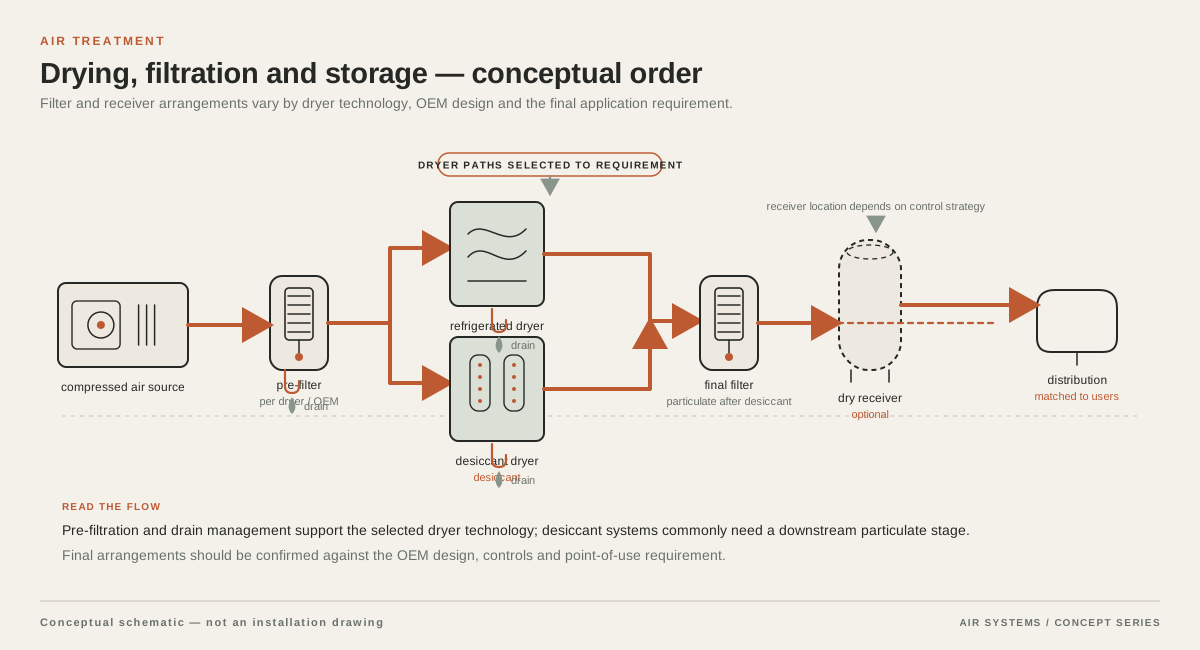
Combine compression, cooling, treatment, storage and distribution at the required pressure and point-of-use air quality. The layout below explains the system interfaces; it is not a photograph of an installed project.
DETAILED SELECTION & OPERATION
What compressed air treatment is designed to control
Atmospheric air carries water vapour and particles into the compressor. Compression raises the concentration of contaminants, while cooling can turn water vapour into liquid condensate. Oil-injected compression can also introduce oil aerosol or vapour; even an oil-free compression process does not by itself remove all downstream particles, water or contamination from the installation. Treatment therefore has separate duties: remove bulk liquid, reduce aerosols and particles, dry the air to a specified pressure dew point, and manage condensate safely.
ISO 8573-1:2010 classifies compressed-air purity with respect to particles, water and oil, independent of where the air is specified or measured. It also identifies gaseous and microbiological contaminants and links to related measurement parts. A requested class should be written as three contaminant requirements and tied to a sampling location. A filter element certificate or a compressor description is not proof that the complete installed assembly will meet the requested class. ISO 8573-1:2010
- Water control: aftercooling, separators, drains and drying address different forms of moisture.
- Particle and aerosol control: filter type, grade, arrangement and monitoring must match the risk and flow.
- Condensate control: drains and any oil-water separation arrangement must be designed for the actual discharge.
How the treatment train relates to the compressor and receiver
A practical system is usually assessed as a train rather than as isolated components. Compressor discharge cooling may condense bulk water before a separator. A receiver can provide storage and help absorb demand changes, but it is not a substitute for a dryer or correctly selected filters. Filters need a defined flow direction, drains and access for element replacement. The dryer must be selected for the actual inlet pressure, temperature, ambient conditions and flow, and the final filter arrangement must protect the distribution system and the process point.
Choose a dryer by pressure dew point and operating conditions
Start with the coldest point where compressed air will travel or be used. The required pressure dew point should be lower than the credible pipe or equipment temperature with a suitable engineering margin. A refrigerated dryer may suit general plant air when the required dew point is compatible with the room and distribution conditions. A desiccant dryer may be considered for colder outdoor lines, instrumentation, exposed process lines or a tighter moisture requirement, but regeneration method, purge or blower demand, inlet protection and desiccant dust control affect the total system.
Select separators and filters around contaminant load
Bulk separators and drains remove liquid water and larger carryover; they do not replace fine coalescing or particulate filtration. Coalescing filters are selected for liquid aerosol and oil aerosol control, while particulate or dust filters address solid contamination. Activated-carbon or vapour-removal stages, where appropriate, are a separate treatment decision and need a defined replacement criterion. Filter housings should be checked for rated flow, inlet pressure, temperature, material compatibility, drain type, differential-pressure indication and safe access.
Oversizing can reduce velocity and pressure loss, but it does not guarantee a target purity class. Undersizing can create avoidable pressure drop and shorten element life. Ask for clean and loaded pressure-drop data at the RFQ flow and for the assumed contaminant loading. If a filter is claimed to protect a downstream process, specify the point-of-use sampling location and whether the claim concerns particles, water, oil aerosol, oil vapour or another contaminant.
Treat condensate management as part of the package
Condensate is generated as compressed air cools, especially around aftercoolers, separators, receivers and filters. A timed drain can waste air or fail to discharge under changing conditions; a zero-loss or demand-controlled drain may reduce that risk but still needs correct installation, strainer access and a failure indication. Multiple drains should be routed so that a blocked or isolated point does not flood a filter, dryer or receiver.
The discharge may contain oil even where the compressor is described as oil-free, because contamination can enter from pipework, ambient air or maintenance materials. Confirm the applicable local discharge rules and whether condensate treatment, collection or sampling is required. The RFQ should identify each drain location, power and signal requirements, high-level alarms, frost protection and the proposed route to the approved disposal arrangement.
Check installation, access and pressure-drop consequences
Treatment equipment needs more than a connection size. Confirm the installation altitude, ambient temperature range, ventilation or cooling-water conditions, indoor or outdoor exposure, electrical supply, noise constraints, pipe material, isolation valves, bypass philosophy and lifting or maintenance clearances. Locate wet-side components so that condensate can drain without pooling. Protect desiccant equipment from liquid carryover and provide the access required for filter and desiccant service.
RFQ data to confirm before selecting treatment equipment
A credible treatment quotation needs operating data, not just compressor nameplate pressure. Provide the normal, minimum and peak flow; flow reference conditions such as FAD, actual volume or normalized volume; inlet and outlet pressure; compressor type and oil-management arrangement; inlet temperature; ambient or cooling-water conditions; operating hours; load cycling; and future expansion allowance. Identify whether the dryer sees the full peak, whether a receiver changes the profile, and whether multiple compressors operate in parallel.
- Flow: normal, minimum, peak, duty cycle, reference basis and expansion factor.
- Conditions: pressure, temperature, humidity or cooling medium, altitude and ambient range.
- Quality: ISO 8573-1 target by contaminant, sampling point and test method.
- Layout: receiver position, pipe temperatures, bypasses, isolation, drains and maintenance clearances.
- Compliance: local pressure-vessel, electrical, environmental and condensate-disposal requirements.
- Deliverables: P&ID, datasheets, pressure-drop data, utilities, alarms, spares and verification plan.
Plan maintenance and verify the installed result
Maintenance intervals depend on the equipment design, inlet contamination, ambient conditions, duty cycle and the OEM's instructions. Plan inspection of drains, filter differential pressure, dryer operating indicators, dew-point measurement, receiver condition and condensate routing. Replacing elements or desiccant without correcting liquid carryover, leaks or an overloaded dryer may not restore performance. Keep service records that identify the component, operating hours, observed condition and replacement reason.
SELECTION & OPERATION
Frequently asked questions
Does an air dryer replace compressed air filters?
No. A dryer addresses moisture according to its operating principle and specified pressure dew point. Separators and filters address liquid, aerosols and particles, and may be required to protect the dryer or the downstream process. The correct sequence and grades depend on inlet contamination, flow, the required air-quality class and the supplier's confirmed design.
Is oil-free compressed air automatically safe for a process?
No. Oil-free describes the compression process, not every possible contaminant in the installed air system. Ambient particles, water, pipe scale, maintenance materials and downstream contamination can still matter. Specify the required ISO 8573-1 contaminant limits, sampling point and verification method, then obtain evidence for the complete operating assembly.
Should I choose a refrigerated or desiccant dryer?
Choose from the required pressure dew point and the coldest credible downstream condition, then compare flow, inlet temperature, ambient conditions, pressure drop, regeneration or purge demand, utilities and maintenance. A refrigerated dryer may fit general plant air; a desiccant dryer may be appropriate for tighter moisture control. Neither choice can be made reliably from nominal flow alone.
Technical references
- Improving Compressed Air System Performance (DOE compressed air sourcebook) ↗
Supply-side treatment context, including the role of dryers and filters in compressed air systems. The PDF text extraction was not reliable in this session, so no page-specific numerical claim is taken from it.
- Compressed Air Treatment (Dryers and Filters), CAGI Compressed Air and Gas Handbook, Chapter 3 ↗
Technical reference for compressed-air drying, filtration and dew-point concepts; supplier performance still requires confirmation at stated operating conditions.
- ISO 8573-1:2010 — Compressed air — Part 1 ↗
The standard's scope: purity classes for particles, water and oil independent of measurement location, plus identification of gaseous and microbiological contaminants and links to measurement parts.