Complete compressed air system.
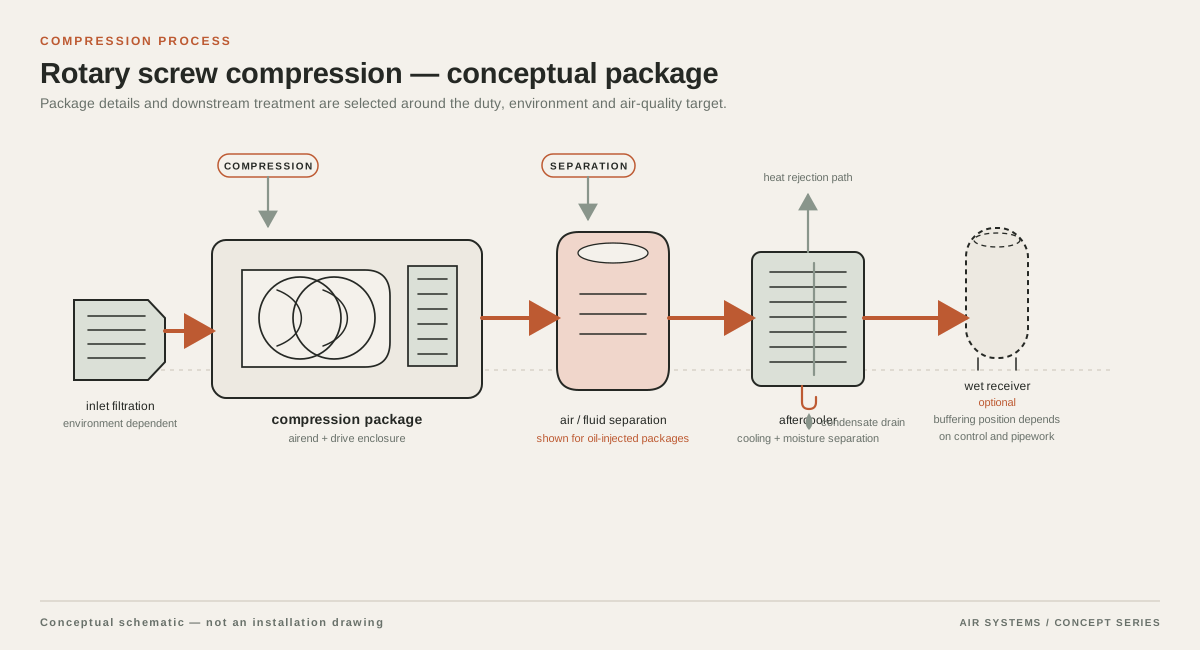
Combine compression, cooling, treatment, storage and distribution at the required pressure and point-of-use air quality. The layout below explains the system interfaces; it is not a photograph of an installed project.
DETAILED SELECTION & OPERATION
What a tank mounted package includes
In practical terms, the tank is the compressed-air receiver and the screw compressor is the source package mounted with it. A package may also be arranged with a motor, separator and controls, plus optional items such as a dryer, filters, drains or a weather enclosure. The CAGI compressed air handbook describes tank-mounted rotary compressor systems as packages that can include an enclosure and accessory equipment. Exact contents vary by supplier and must be stated line by line in an offer.
A receiver stores air between generation and use. It can absorb short demand changes when storage and controls are properly selected, but it is not a substitute for sustained compressor capacity. Ask whether the quoted outlet is before or after the receiver, dryer and filters.
- Compressor element, drive, motor and package controller: confirm whether these are included.
- Receiver: confirm usable volume, design pressure, connections, drain arrangement and local vessel requirements.
- Treatment and accessories: identify the dryer, filters, condensate management, isolation valves and safety devices separately.
- Mounting and enclosure: confirm footprint, lifting points, noise treatment, ventilation and indoor or outdoor suitability.
When the compact format is a good fit
Tank mounting is worth comparing where the installation needs a compact, pre-arranged package and demand is stable or has short intermittent peaks. A workshop, production cell, maintenance area or remote point may benefit from fewer supports. The decision still depends on service access, receiver transport, ventilation, electrical capacity and the route to the point of use.
The format is less attractive when the site needs several compressors, a large central receiver, extensive drying, multiple pressure zones or expansion. A separate receiver and treatment train may provide better layout flexibility and isolation. Check clearances around the element, separator, filters, drains, motor and receiver inspection points before accepting the footprint.
Match the receiver to the operating profile
Start with a demand profile rather than a tank rule of thumb. Record average flow, maximum sustained flow, short peak events, shift pattern, idle periods and the minimum pressure required at the machine. A receiver can buffer a brief peak, but the available pressure band, control logic, outlet flow and treatment pressure drop determine how useful that stored volume will be. The Compressed Air Challenge guidance on high-volume intermittent demand treats receivers as storage for peak events and pressure control, not as a replacement for a properly designed source.
For a cyclic load, ask the supplier to explain how the package responds to load and unload, modulation or variable-speed control, and how frequently the motor is expected to start. For a process that runs continuously near maximum demand, prioritize verified delivered flow at the required pressure and provide storage for control stability or peak events. Any calculation must state whether pressure is absolute or gauge, the flow reference, the temperature basis and the usable pressure swing.
| Buyer situation | Configuration to compare | Confirm before RFQ award |
|---|---|---|
| Stable load with limited space | Tank-mounted package with standard receiver and separate treatment if needed | Delivered flow at pressure, footprint, service clearances, vessel documentation and outlet arrangement |
| Intermittent pneumatic demand | Receiver-led buffering with suitable controls and drain management | Peak duration, pressure band, recovery time, cycling behavior and usable receiver volume |
| Wet or quality-sensitive air | Tank-mounted source plus specified dryer, filters and condensate handling | Pressure dew point, particle/oil requirements, filter pressure drop, drain type and measurement evidence |
| Expansion or multiple pressure zones | Separate central receiver and modular compressor/treatment arrangement | Future flow, zoning, redundancy, isolation points, controls integration and room layout |
Place treatment and define the air outlet
A tank-mounted compressor does not by itself define air quality. Atmospheric moisture enters with intake air, and compression creates condensate that must be separated, drained and managed. Depending on the required pressure dew point and contamination limits, the package may need a refrigerated or desiccant dryer, particulate and coalescing filters, an appropriate drain and point-of-use treatment. Compare the pressure drop of the complete train at the required flow, not just the compressor discharge pressure.
Specify whether the buyer needs air at the receiver outlet, after a dryer and filters, or at the machine connection. Those locations can have different pressure, flow and quality conditions. If the application has a stated ISO 8573-1 class, identify the required class by particle, water and oil categories and ask for evidence for the complete delivered arrangement. A component certificate is not assembly approval, and oil-free wording alone is not a blanket food-safety or zero-contamination assurance.
Check installation before choosing the footprint
Confirm the floor load, receiver orientation, anchoring, lifting route and access for inspection. The compressor room needs adequate intake and exhaust ventilation for the actual heat rejection and ambient temperature. Verify the electrical supply, starter or drive arrangement, short-circuit requirements, earthing and control interface with the site electrician.
Plan the connection as a system. Include an isolation valve, suitably rated flexible connection where required, downstream piping, condensate discharge, drains routed to an approved arrangement and a relief or safety device consistent with the vessel and local rules. Receiver pressure-vessel inspection, registration and periodic testing are jurisdiction-specific; obtain the responsible authority’s requirements rather than relying on a generic tank label.
Plan service access and lifecycle work
A compact package concentrates service items in one location. The RFQ should show access for filters, drive components, coolers, drains, valves and controller inspection. Maintenance intervals depend on the OEM design, ambient temperature, intake cleanliness, operating hours and load profile; obtain them from the proposed supplier’s manual.
Ask how condensate is drained, how alarms are recorded, and what happens after a power interruption or high-temperature trip. Request spares, service response, warranty boundaries and commissioning procedure. If the receiver or treatment train is isolated for service, confirm whether the process has enough alternate storage or standby capacity to remain safe.
Applications and limits to state clearly
Tank-mounted screw packages can be compared for general manufacturing, workshops, machine tools, packaging auxiliaries and other uses where a rotary source and local storage suit the demand. They are not automatically the right answer for every pressure or purity requirement. High-pressure duties may need a purpose-designed compressor or booster; process-critical air may need a validated treatment and monitoring scheme; hazardous areas need classification-specific equipment and whole-assembly evidence.
Do not select solely from motor power, tank size or a headline compressor pressure. Request performance at the actual ambient condition and pressure, with the measurement standard and reference conditions stated. If the process has rapid peaks, compare a larger central receiver, local receiver, sequencing controls or additional compressor capacity rather than assuming the tank-mounted format will cover every transient.
RFQ data to confirm with a supplier
A useful quotation request makes the supply boundary unambiguous. Include required air at the point of use, not just the compressor nameplate target. Give the normal, minimum and maximum ambient temperature; elevation; intake conditions; operating hours; shift pattern; duty cycle; pressure range; peak duration; and whether future capacity is expected. State the flow unit and reference conditions, such as FAD or a normalized flow basis, and require the supplier to state its own basis beside every quoted value.
Ask for a marked-up process and instrument diagram or equivalent schedule showing the compressor, receiver, valves, drains, dryer, filters, sensors and outlet. Require a proposed footprint and service clearances, utility schedule, noise data if relevant, commissioning tests, vessel documentation and the evidence offered for air quality. These are quotation requirements to confirm, not specifications currently offered by this site.
- Required delivered flow, minimum outlet pressure and pressure tolerance at the point of use.
- Normal and peak demand profile, peak duration, recovery expectation and control preference.
- Receiver volume and design basis, including local pressure-vessel compliance and inspection documents.
- Air quality target, pressure dew point, filter grades, condensate route and test or monitoring evidence.
- Electrical supply, ambient limits, ventilation, noise limit, footprint, lifting route and service clearances.
- Scope split for compressor, receiver, treatment, piping, installation, commissioning, training and spares.
SELECTION & OPERATION
Frequently asked questions
Does a tank mounted screw compressor include a dryer?
Not necessarily. A tank-mounted arrangement may include only the compressor and receiver, or it may be offered with a dryer, filters, drains and enclosure. The quotation must list each item and identify the air outlet location. Confirm pressure dew point, filter performance and pressure drop for the complete treatment train.
Is a larger receiver always better for a screw compressor?
No. Storage should reflect the demand pattern, control method, usable pressure band and local vessel requirements. A larger receiver may help with short intermittent peaks, but it cannot replace sustained compressor capacity or fix an undersized pipe, unsuitable dryer or excessive pressure drop.
Can a tank-mounted package supply a whole factory?
It can be compared for that role only after the factory demand, pressure zones, treatment needs, redundancy, expansion and distribution layout are assessed. A central receiver and modular compressor room may be more maintainable than one compact package. Require a system proposal rather than choosing from the tank size alone.
What should I request for a tank-mounted compressor RFQ?
Request delivered flow and pressure at stated reference conditions, demand and peak data, receiver design information, treatment and air-quality targets, utilities, ambient limits, footprint and service clearances, vessel compliance documents, commissioning tests, warranty scope and a clear split between standard and optional configuration items.
Technical references
- Compressed Air and Gas Institute Handbook, Chapter 2: Compressed Air Production ↗
Supports the description of rotary compressor packages and the possibility of tank-mounted systems with enclosure and accessory equipment.
- Improving Compressed Air System Performance: A Sourcebook for Industry ↗
Supports the role of receivers as stored compressed air and the need to consider storage within whole-system performance and controls.
- Compressed Air Challenge: Dealing with High-Volume Intermittent Demands ↗
Supports using receivers to address peak demand events and pressure control while distinguishing storage from sustained source capacity.