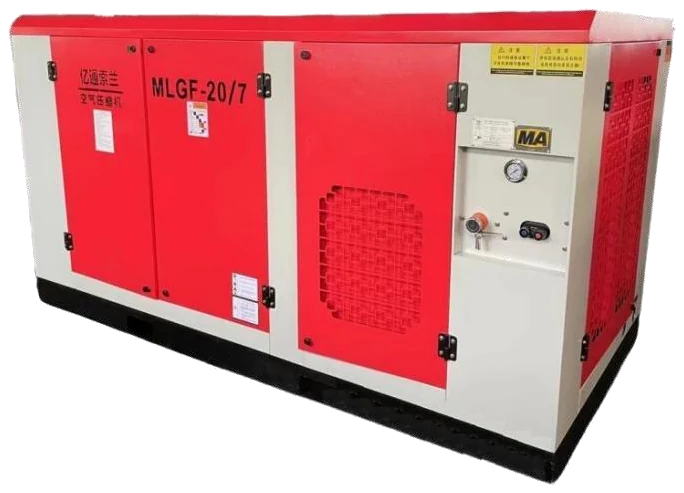
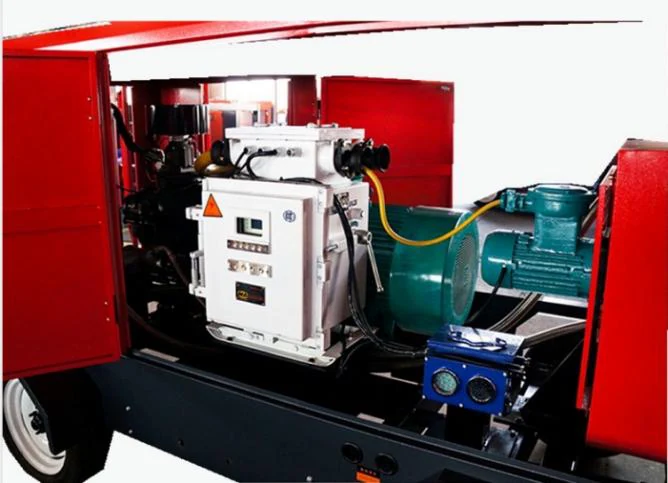
Complete compressed air system.
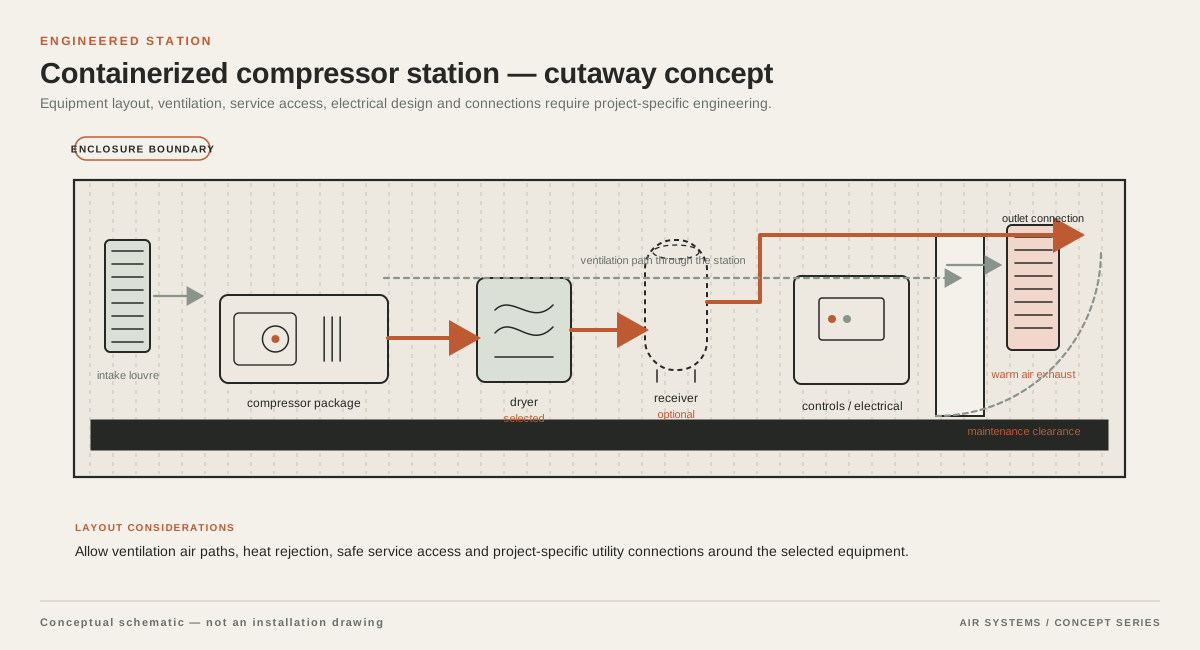
Combine compression, cooling, treatment, storage and distribution at the required pressure and point-of-use air quality. The layout below explains the system interfaces; it is not a photograph of an installed project.
DETAILED SELECTION & OPERATION
When hazardous-area compressor design is appropriate
Use this design route when the compressor or its associated electrical and mechanical equipment will be installed inside, adjacent to or connected with a classified area. The classification may arise from flammable gases or vapors, combustible dust, or fibers. The area owner or hazardous-area engineer should define the classification before a supplier proposes equipment. In the United States, OSHA requires equipment to be approved for the class of location and for the ignitable or combustible properties of the specific gas, vapor, dust or fiber present. That means a general “explosion-proof” description is not enough.
A remote compressor room with properly routed air piping can reduce the amount of equipment requiring hazardous-area assessment, but the room location, penetrations, isolation, ventilation and connected devices still need engineering review. Do not relocate equipment as a compliance shortcut.
- Appropriate starting point: a documented hazardous-area classification and a defined compressor installation boundary.
- Not sufficient: a motor or control-box certificate presented as approval of the compressor package or site installation.
- Potential alternative: locate the compression train outside the classified zone and assess only the equipment that remains in or crosses the zone.
Build the protection basis from the site classification
The RFQ should state the classification system used by the project: for example, Class and Division, Zone, or the applicable regional framework. It should identify whether the hazard is gas or vapor, combustible dust, or fiber; the gas or dust group; the required temperature class or maximum surface temperature; ambient temperature; and the zone or division. OSHA’s hazardous-location rule illustrates why these details matter: equipment approved for one class is not automatically suitable for another.
Ask the supplier to map every item in the proposed boundary to the required protection concept. This can include the motor, terminal box, starter or variable-speed drive, sensors, solenoids, fans, heaters, lights, junction boxes, cable glands and instrumentation. The protection method must be appropriate to the location and equipment, and the installation must preserve that protection. A compliant component can become unsuitable if installed outside its certificate conditions or with incorrect cable entry, temperature, electrical parameters or enclosure arrangement.
| RFQ input | Why it changes the design | Evidence to request |
|---|---|---|
| Area classification and zone/division | Defines the permitted equipment category and protection basis | Approved area drawing and supplier applicability statement |
| Gas/vapor or dust/fiber identity and group | Ignition behavior and material properties affect suitability | Marking, certificate scope and limitations |
| Temperature class or maximum surface temperature | Limits hot surfaces and may constrain ambient operation | Temperature rating at stated ambient and duty |
| Ambient, altitude and ventilation conditions | Affect cooling, enclosure temperature and motor/drive loading | Thermal calculation or installation conditions |
Treat the compressor as a complete system boundary
Define whether the supply includes the compressor element, motor, coupling or belt drive, base, enclosure, aftercooler, separator, receiver, dryer, filters, control panel, starter or drive, local isolator, instrumentation and ventilation equipment. Then state which items are owner-supplied and which are included by the package supplier. This prevents a protection gap at interfaces. For example, a certified motor does not establish the temperature, ignition control or installation suitability of a belt guard, cooler fan, drain valve, control panel or complete skid.
IECEx explains that a Certificate of Conformity applies to complete Ex equipment, while a component certificate applies to a component that is not intended to be used alone and requires additional certification when incorporated into equipment. IECEx also describes unit verification for individual one-off or limited-series items. Request the exact certificate type, certificate number, assessed configuration, conditions of use and certificate-holder identity. Where a skid is assembled from certified parts, request the assessment that covers the assembled unit rather than assuming the parts collectively provide assembly approval.
Select compression technology around the operating profile
Explosion protection does not determine whether the compression element should be rotary screw, reciprocating or another arrangement. Select technology from required flow, discharge pressure, duty cycle, starts, turndown, air quality, noise, maintenance access and the consequences of a trip. State the flow basis, inlet and discharge conditions, and point-of-use pressure after treatment and distribution losses. Avoid choosing by motor rating alone.
Intermittent demand can require receiver capacity, sequencing or a control strategy that avoids repeated starts. Continuous demand may favor a different loading arrangement. For hazardous areas, ask how starting current, hot surfaces, oil carryover, condensate drainage, emergency shutdown and restart behavior are controlled. Any claims about efficiency, acoustic level, service interval or service life should be tied to a named configuration and duty rather than treated as a property of the category.
Coordinate ventilation, cooling and installation interfaces
Compression converts electrical input into heat, so the room or enclosure needs a documented heat-rejection and airflow design. Confirm the permitted ambient range, inlet-air temperature, discharge-air temperature, cooler arrangement, fan protection, ventilation failure response and any required extraction or dilution. The ventilation design must not defeat the hazardous-area classification or introduce an ignition source. Ask for the thermal basis and alarm or shutdown setpoints instead of accepting a generic room-size recommendation.
Installation details are part of the protection case. Confirm cable glands, conduit or wiring method, bonding and earthing, drainage, separation from process releases, access for inspection and maintenance isolation. If a receiver or dryer is included, include its location and connected electrical devices in the interface review.
Specify treatment without confusing air quality with Ex protection
Explosion protection addresses ignition risk; it does not automatically deliver dry, clean or oil-free compressed air. Define the point-of-use pressure dew point, particles, oil and other contaminants required by the process. Select aftercooling, condensate separation, filtration, drying and drainage around the actual climate, piping length and receiver arrangement. If the process has a flammable or reactive material exposure, obtain a separate process-safety review for the air stream and any vent or drain discharge.
Treatment equipment installed in the hazardous area must be included in the boundary review. Verify protection for dryers, drain controls, fans, heaters, valves and analyzers. Treat any oil-free claim as requiring evidence, not as a blanket process-safety or food guarantee.
Plan inspection and maintenance around the assessed configuration
Maintenance must preserve the conditions under which the equipment was assessed. Request manuals and inspection instructions for the exact proposed configuration, including permitted replacement parts, fastener and gland requirements, enclosure integrity, surface-temperature controls, lubrication, cleaning, drain checks and post-maintenance testing. Intervals depend on OEM instructions, ambient conditions, duty, contamination and local rules; no universal interval should be assumed.
The handover dossier should identify the complete equipment boundary, nameplates and markings, applicable certificates or declarations, certificate conditions, drawings, wiring diagrams, heat and ventilation calculations, factory tests and commissioning checks. Align it with the owner’s hazardous-area inspection and permit-to-work procedures.
RFQ selection-to-confirm checklist
Use the following as a request-for-quotation schedule, not as a supply specification. Ask each bidder to mark every line as included, excluded, supplier-confirmed, owner-supplied or requiring a project decision, and to list deviations explicitly.
Compare quotations on the same flow reference, pressure basis, inlet condition, ambient range, duty profile, treatment endpoint and package boundary. Request guaranteed values only where the contract defines the test method and acceptance conditions.
| RFQ item | Supplier response required |
|---|---|
| Hazardous-area basis | Classification, substance group, temperature class, ambient range and applicable jurisdiction acknowledged |
| Equipment boundary | P&ID or general arrangement showing compressor, motor, controls, cooling, treatment, receiver and interfaces |
| Protection evidence | Certificate/declaration type, number, holder, assessed configuration, conditions of use and certificate limitations |
| Performance basis | FAD or stated flow reference, inlet conditions, discharge pressure, pressure tolerance, duty cycle and noise basis |
| Electrical and controls | Supply, fault level, starting method, drive details, shutdown logic, signals, glands and earthing requirements |
| Thermal and ventilation | Heat rejection, airflow, fan protection, high-temperature response and installation assumptions |
| Air quality | Aftercooler, separator, filters, dryer, drains and point-of-use acceptance limits |
| Lifecycle | Maintenance instructions, inspection needs, spares, training, commissioning tests and exclusions |
SELECTION & OPERATION
Frequently asked questions
Does an IECEx certificate for the motor certify the whole compressor skid?
No. IECEx distinguishes a certificate for complete Ex equipment from a component certificate, and a component may require additional certification when incorporated into a system. Request evidence for the assembled package and confirm the certificate scope, conditions of use and interfaces.
Can any compressor be installed in a Zone 1 or Class I area if it has an explosion-proof motor?
No. The motor is only one part of the installation. The compressor, controls, sensors, cooling fans, wiring entries, hot surfaces and mechanical equipment must be assessed against the site classification, substance group, temperature limits and applicable local requirements.
Is a remote compressor room always the safer answer?
It can reduce the equipment located inside the classified area, but it is not automatically compliant. Confirm the room classification, air-pipe penetrations, isolation, ventilation, connected equipment and any release path with the project hazardous-area engineer.
Does explosion protection guarantee clean or oil-free compressed air?
No. Ignition protection and compressed-air quality are separate design objectives. Specify filtration, drying, condensate management and point-of-use acceptance limits independently, then request evidence for the selected treatment and sampling method.
Technical references
- OSHA 1910.307 Hazardous (classified) locations ↗
Equipment suitability for the class of location and the specific gas, vapor, dust or fiber; examples of classification, group and temperature marking requirements.
- IECEx Certified Equipment Scheme overview ↗
Independent assessment, Certificate of Conformity for complete equipment, component certificates, unit verification, and the need to check certificate scope and online records.
- ISO 80079-36:2016 Explosive atmospheres ↗
Published standard reference for the ISO 80079-36 series concerning non-electrical equipment for explosive atmospheres; the page does not establish a supplier or package certificate.