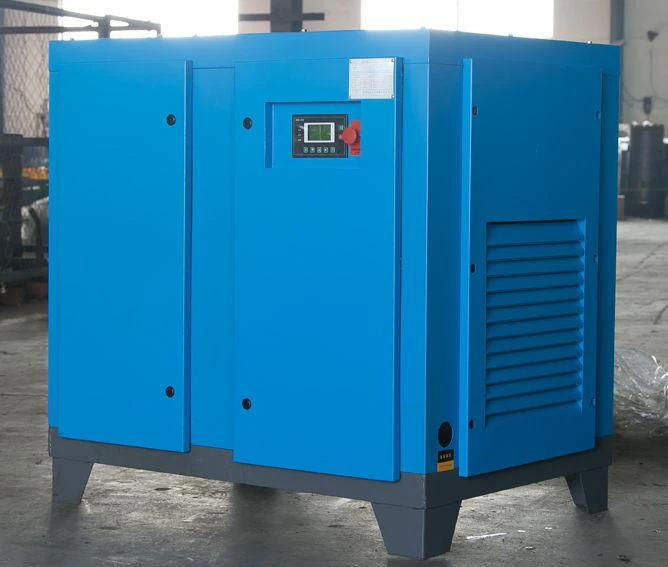
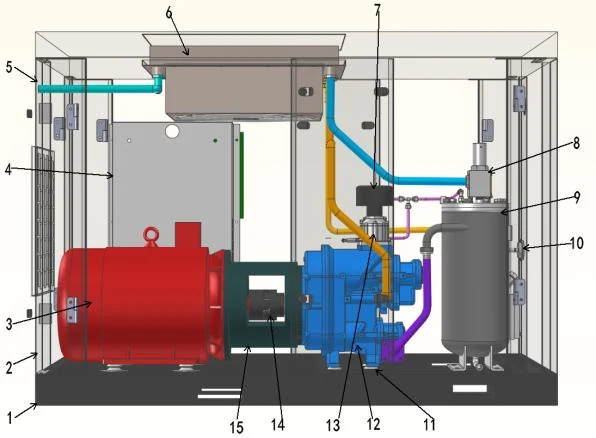
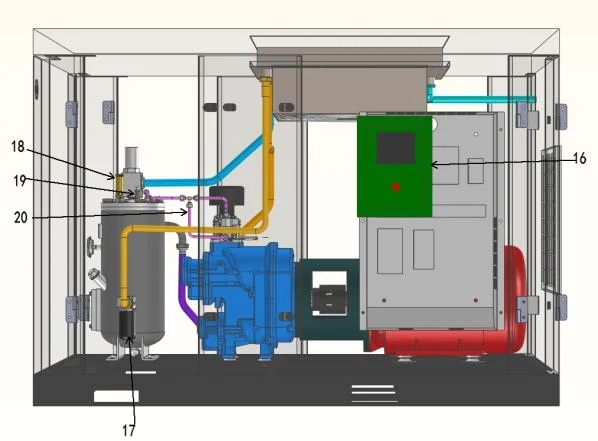
Complete compressed air system.
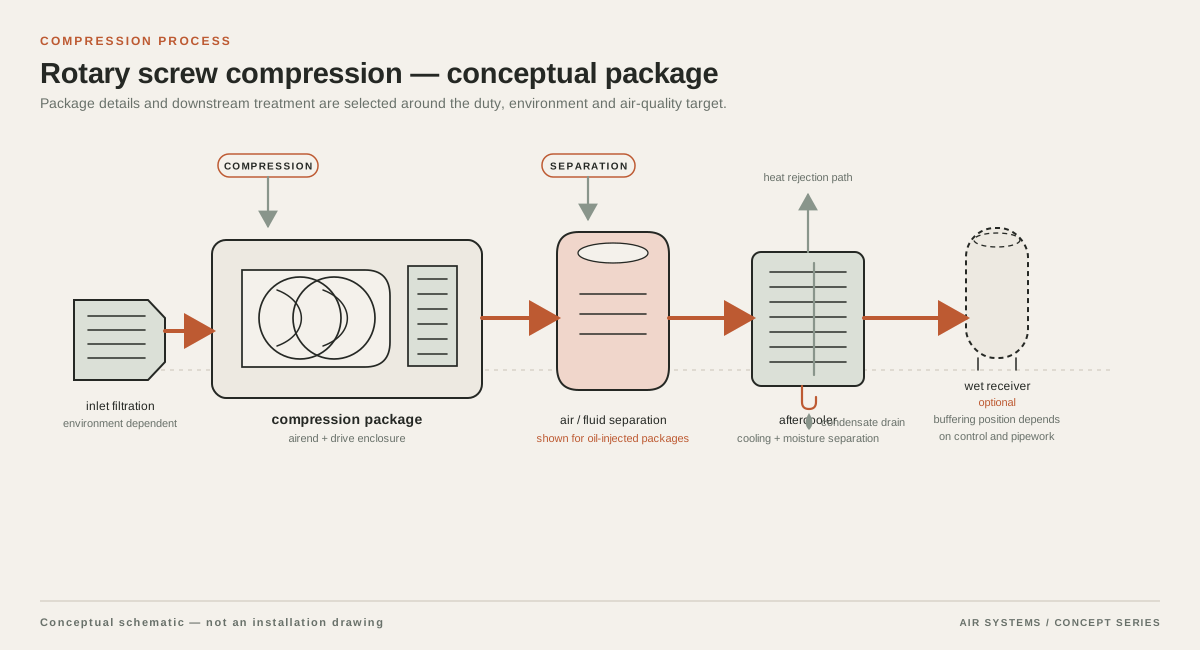
Combine compression, cooling, treatment, storage and distribution at the required pressure and point-of-use air quality. The layout below explains the system interfaces; it is not a photograph of an installed project.
DETAILED SELECTION & OPERATION
When variable-speed control is a good fit
Start with the plant demand profile rather than motor size. A VSD package is most relevant where flow rises and falls during shifts, where production changes by product or batch, or where several operating states create sustained periods below peak demand. The drive can vary compressor speed so capacity follows the control target more closely than a simple fixed-speed load/unload arrangement. That potential should be tested against measured flow, pressure and power data; it is not a guaranteed saving or a substitute for leak repair and correct pressure management.
- Obtain a representative demand profile covering production, idle periods, weekends and planned future changes.
- Separate continuous base load from intermittent peaks and short events.
- Check whether the proposed unit's confirmed minimum and maximum operating points cover the real profile.
- Treat any efficiency or payback statement as supplier-specific and dependent on verified assumptions.
How a VSD screw package controls air delivery
Do not compare a drive alone with a complete compressor system. Drive losses, motor characteristics, compressor element behavior, cooling fans, oil separation or treatment equipment, blowdown strategy and standby operation all affect package performance. Request performance data at named operating points and ask the supplier to state whether values are input power, package power, shaft power or another basis. CAGI describes VSD compressors as a way to vary output with fluctuating demand, but application and sizing remain central to the result.
Size from flow, pressure and duty—not horsepower
The RFQ should state required delivered flow using an explicit reference basis such as FAD, actual cubic metres per minute, CFM or normalized flow. Do not mix units without recording reference pressure, reference temperature and humidity assumptions. State the required pressure at the point of use, the acceptable pressure band, and the pressure available at the compressor discharge. Include treatment pressure loss, receiver arrangement, distribution loss and any elevation or ambient effects that matter to the installation.
Peak flow and average flow answer different questions. A VSD compressor selected only for the average can fail to cover a process peak; selected only for peak can spend too much time near its low operating limit. Describe peak duration, repetition, ramp rate and whether a receiver can buffer the event. For multiple compressors, ask for a lead/trim sequence and the conditions under which another machine starts. A supplier should confirm the proposed operating envelope and explain what happens at minimum demand, not merely quote a nominal motor rating.
| Buyer requirement | What to compare | Confirm in the quotation |
|---|---|---|
| Variable demand | Measured flow and pressure profile versus control range | Minimum and maximum delivered flow, response behavior and assumptions |
| Required pressure | Point-of-use pressure and distribution losses | Pressure basis, control location, allowable band and discharge pressure |
| Peak events | Peak duration, frequency and receiver support | Peak coverage, restart/sequence logic and receiver recommendation |
| Energy comparison | Same duty, hours, tariff and delivered-air basis | Package input power data and test conditions at relevant loads |
| Installation | Ambient, altitude, cooling and electrical conditions | Allowable limits, heat rejection, drive requirements and protection |
Standard versus optional configuration items
Ask whether each item is included, optional, excluded or subject to site design. For a VSD unit, confirm drive enclosure rating, harmonic mitigation, bypass or safe-stop philosophy, motor compatibility, cable requirements and electrical fault protection with the responsible electrical engineer. Do not infer a compliance approval from a component certificate. Whole-package conformity, local electrical rules, pressure-vessel rules and site inspection requirements need separate confirmation.
- Usually evaluated as part of the package: compressor element, motor, drive, controller, separator or discharge arrangement, aftercooling and basic protective instrumentation.
- Often application-dependent: receiver, dryer, filters, condensate treatment, heat recovery, remote monitoring, acoustic enclosure and master sequencing.
- Always confirm: utility voltage and frequency, cooling medium, ambient limits, altitude derating, ventilation, access clearances and lifting or service provisions.
Treat the compressor, receiver and air treatment as one system
A VSD compressor does not remove the need for storage and distribution design. A receiver can reduce rapid cycling, support short peaks and provide a stable measurement environment, but its size and location depend on demand behavior, pressure band, compressor response and local vessel requirements. The receiver must be selected and protected under the jurisdiction that applies to the installation; do not treat a quoted tank volume as approval for the site.
Aftercooling, moisture separation, dryers and filters add pressure loss and maintenance points. Specify the required pressure dew point and air-quality class at the relevant point of use rather than selecting treatment by compressor label. If different users have different cleanliness or dryness needs, compare point-of-use treatment with conditioning the whole plant. Ask for drain type, condensate handling, differential-pressure monitoring and service access.
RFQ data to send before comparing offers
A useful RFQ lets suppliers price the same duty. Provide the process description, operating schedule, current compressor inventory, measured flow and pressure trend, required air quality, utility data and installation constraints. State what is known and what must be surveyed. Include future expansion as a scenario rather than silently adding an unverified margin. Ask each bidder to return a marked schedule of deviations and assumptions.
Request a selection narrative, not just a model number. The response should show how the package covers base load, peaks and low-demand periods; identify receiver and treatment duties; state control location and pressure band; and disclose the test or calculation basis for flow and power. If the supplier proposes a fixed-speed companion or master controller, require the sequence and operating logic to be explained.
- Required flow: average, minimum, maximum, peak duration and event frequency, with reference conditions and units.
- Pressure: point-of-use requirement, compressor discharge target, allowable fluctuation and estimated distribution or treatment losses.
- Air quality: required dew point, particles, oil and other contaminants at each critical user, with the applicable standard or process requirement.
- Site: altitude, ambient temperature range, cooling water if relevant, room ventilation, available floor space, noise limits, electrical supply and hazardous-area classification if applicable.
- Commercial: operating hours, duty pattern, electricity tariff assumptions, service scope, warranty terms, commissioning tests, exclusions and required documentation.
What this page can and cannot establish
This page explains how to compare variable-speed screw compressor configurations. It does not identify a verified supplier model, guarantee a pressure or flow rating, promise a percentage energy reduction, certify an installation, or state that any unit is in stock. A quoted performance value is meaningful only with its measurement basis, inlet conditions, pressure, temperature, humidity, tolerances and package scope. Compare like with like and obtain written supplier confirmation before procurement.
SELECTION & OPERATION
Frequently asked questions
Are variable-speed screw compressors always more efficient than fixed-speed compressors?
No. Variable-speed control can be useful when demand changes, but the result depends on sizing, the operating range, control settings, pressure, installation, maintenance and the comparison basis. A steady base load or prolonged operation near an unsuitable minimum point may favor another configuration. Ask for package input power at the actual duty profile and compare it with a fixed-speed or multi-compressor alternative using identical assumptions.
How much receiver capacity does a variable-speed compressor need?
There is no universal receiver size. Capacity depends on the compressor response, pressure band, peak flow and duration, minimum operating point, sequencing and the vessel rules that apply locally. Provide measured demand data and ask the supplier to show the receiver's role in the control strategy. The quoted vessel still requires site-specific safety and installation confirmation.
Can I choose a VSD compressor from the motor horsepower alone?
No. Motor rating does not state delivered flow, pressure, control range, package power or air quality. Specify flow and pressure on an explicit reference basis, then confirm ambient, cooling, electrical and treatment conditions. The supplier should return performance data at relevant operating points and identify all assumptions and exclusions.
Is a VSD compressor suitable for intermittent peak air demand?
It may be, but intermittent peaks need separate analysis. Check peak duration and frequency, the compressor's response and maximum output, receiver buffering, pressure drop and whether a fixed-speed companion or local storage is more appropriate. Do not assume the variable-speed unit alone will cover a short high-flow event without a documented system calculation.
Technical references
- Technical Brief on Variable Speed Drive ↗
General explanation that properly sized VSD compressor packages vary output with changing compressed-air demand, plus application and sizing considerations.
- Improving Compressed Air System Performance ↗
DOE compressed-air system guidance on capacity controls, system assessment, and the need to evaluate compressor controls in relation to the complete system.
- Compressed Air Evaluation Protocol ↗
DOE evaluation framework supporting measurement of compressed-air demand and control performance before selecting or comparing equipment.