Complete compressed air system.
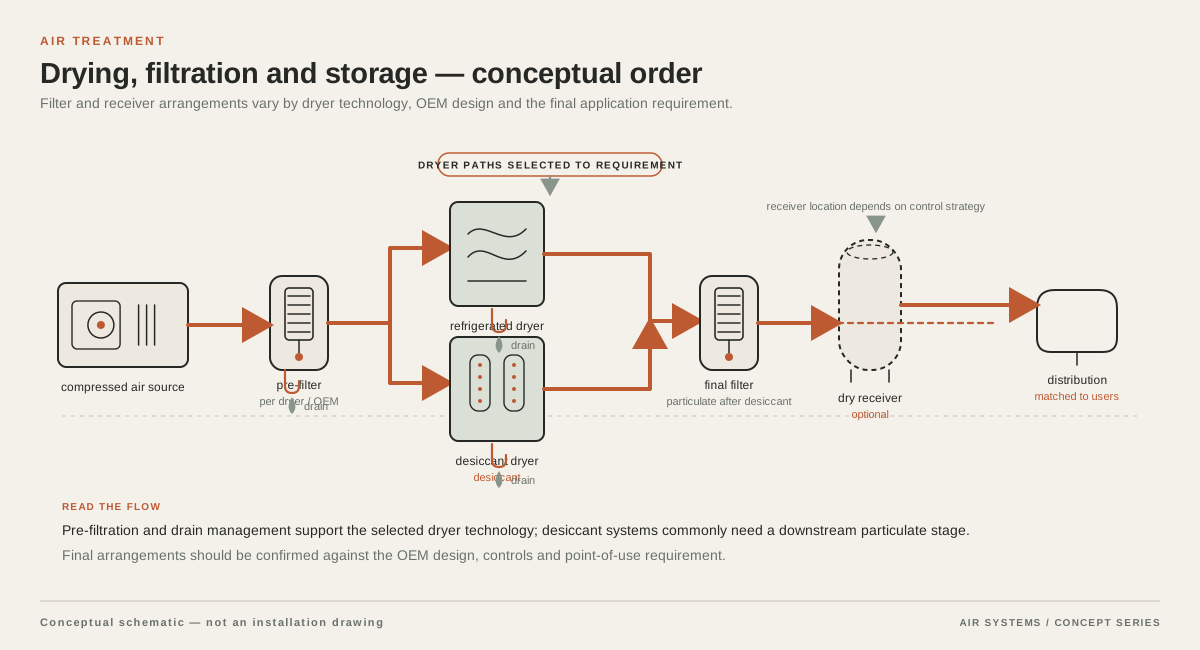
Combine compression, cooling, treatment, storage and distribution at the required pressure and point-of-use air quality. The layout below explains the system interfaces; it is not a photograph of an installed project.
DETAILED SELECTION & OPERATION
How a refrigerated dryer removes moisture
A refrigerated dryer transfers heat from compressed air to a refrigerant circuit. As the air is cooled, moisture condenses; a separator removes the liquid water, and the dried air is normally reheated by exchanging heat with incoming warm air. The outlet pressure dew point is therefore linked to the air temperature leaving the evaporator, not simply to the compressor discharge temperature. The U.S. Department of Energy sourcebook describes this cooling-and-condensation principle, while CAGI explains pressure dew point as the condensation temperature at a stated pressure.
The condensate path matters as much as the heat exchanger. A supplier should identify the drain arrangement and explain how blockage, fouling or loss of power is detected. Treat the drain, separator, bypass and alarms as part of the air-treatment design rather than as incidental accessories.
When refrigerated drying is an appropriate choice
A refrigerated dryer is a candidate when the process can tolerate a pressure dew point above the freezing range and the air will remain warmer than that dew point through the downstream piping. Typical duties include general plant air, pneumatic actuators, machine tools and many instrument-air systems, subject to the equipment maker's required moisture limit. It can be a practical alternative to desiccant drying when very low dew point is not required and avoiding purge-air consumption is important; the actual energy and lifecycle trade-off still needs supplier and site data.
It is not an automatic answer for cold exposed lines, deep-dry processes or any duty that specifies a pressure dew point below what the selected refrigeration circuit can achieve. See desiccant air dryers when the required dew point or environment calls for adsorption drying.
Configuration choices to compare
Non-cycling designs continuously operate their refrigeration circuit while loaded, whereas cycling designs can vary or store cooling capacity as load changes. A cycling arrangement may be relevant to plants with large swings in demand, but the commercial case depends on the real load profile, control strategy, ambient conditions and the supplier's tested input data. A fixed-speed compressor, variable-capacity control or thermal storage are configuration descriptions, not assurances of a particular efficiency outcome.
Air-cooled and water-cooled condensers create different installation dependencies. Air-cooled units need clear ventilation and acceptable room temperature; water-cooled units need a defined water quality, temperature, flow and maintenance plan. Pre-cooling, after-cooling, integrated filtration, hot-gas bypass, dew-point monitoring, remote alarms and a wet-air bypass may be standard, optional or unavailable depending on the proposed assembly. Ask the supplier to mark each item explicitly rather than treating a familiar feature list as a supply specification.
| Comparison point | Why it matters | RFQ confirmation |
|---|---|---|
| Pressure dew point | Determines where condensation risk is controlled and whether the process requirement is met. | State the required PDP, pressure, inlet temperature, ambient or cooling-water basis, and test standard or acceptance method. |
| Flow and load profile | Peak flow, turndown and cycling affect heat load, control response and carryover risk. | Provide normal, minimum and peak flow with units and reference conditions; identify intermittent peaks and future margin. |
| Pressure loss | Dryer, separator, filters and valves consume pressure that may force a higher compressor setpoint. | Request clean and dirty pressure-drop values at the stated flow, plus the measurement locations. |
| Cooling method | Room heat rejection and water-system limits can determine whether installation is practical. | Confirm air or water cooling, design ambient or water conditions, ventilation, utilities and noise data. |
| Drain and monitoring | Condensate handling protects downstream equipment and exposes faults early. | List drain type, failure alarm, dew-point sensor location, high-temperature alarm and remote signals. |
Size from real operating conditions, not nominal flow
Dryer capacity is conditional. A nominal flow rating may be based on a particular inlet pressure, inlet temperature, ambient temperature and target pressure dew point. Changing any of these can change usable capacity or require a correction factor. Give the supplier the compressor outlet conditions at the dryer inlet, not only the compressor nameplate. Also state whether the quoted flow is FAD, standard flow or another reference basis; do not mix m³/min, actual cubic metres per minute, CFM and normalized flow without their pressure and temperature definitions.
Separate continuous base demand from short peaks. A receiver may help manage brief demand events, but it does not make an undersized dryer suitable for a sustained peak. The supplier should show the correction method and resulting selected capacity.
Installation relationship with compressor, filters and receiver
The usual treatment train needs to be designed as a system: compressor aftercooling and condensate separation upstream, the refrigerated dryer, appropriate filtration where required, and a clean distribution path downstream. A receiver can damp demand fluctuations and provide bulk condensate separation when correctly arranged, but it does not replace drying. Drain points need safe discharge and maintenance access.
Pressure dew point is not the whole air-quality specification
Drying addresses water behaviour. It does not by itself establish particle, oil, gaseous or microbiological purity. ISO 8573-1:2010 defines compressed-air purity classes for particles, water and oil, independent of where the air is specified or measured, and also identifies gaseous and microbiological contaminants. Therefore, an RFQ should state the complete required air-quality class and sampling point where relevant, then select filters, oil-control measures and verification methods around that requirement. A refrigerated dryer should not be presented as a food-safety, sterile-air or oil-free guarantee.
Pressure dew point also depends on pressure. A dew-point value measured at the dryer outlet is not automatically equivalent to the moisture condition at a lower-pressure point of use. Ask for the measurement pressure and location, the test conditions, alarm setpoints and the expected behaviour during warm-up, low load and bypass operation. If a branch can cool below the specified dew point, insulate or reconfigure it only after an engineer checks the actual temperature and drainage risk.
Maintenance and lifecycle questions
Maintenance intervals depend on the OEM design, ambient dust, inlet contamination, operating hours, cooling method and load profile. A credible proposal should identify condenser cleaning or water-side maintenance, filter and drain servicing, refrigerant-circuit diagnostics, sensor checks and the conditions that trigger service. Do not accept a universal interval as a guarantee for every site. Ask how a high dew point, high condensing pressure, drain fault or blocked condenser is detected and recorded.
Compare the whole lifecycle rather than compressor input alone. Include refrigeration, fan or pump power, pressure loss, drain air loss if any, consumables, downtime and service access. For variable demand, request a stated part-load test basis.
RFQ checklist for a comparable quotation
Send one consistent operating envelope to every bidder. Include the required pressure dew point at a named pressure and location, normal and peak flow, flow reference conditions, inlet pressure, inlet air temperature, ambient or cooling-water conditions, load variability and installation location.
Request a marked compliance schedule rather than a brochure. It should distinguish standard and optional items, state correction factors, show pressure drop at design flow, define utilities, describe drains and alarms, and list commissioning tests. Require the supplier to identify assumptions, exclusions and data still to be confirmed.
- Required PDP, measurement pressure, measurement location and acceptance method
- Normal, minimum and peak flow with FAD, actual or normalized reference defined
- Inlet pressure and temperature range, ambient or cooling-water design conditions
- Cooling method, electrical supply, ventilation or water utilities and service clearances
- Pressure-drop curve or values for the dryer, filters and valves at stated flow
- Drain type, condensate handling, alarms, remote signals and dew-point monitoring
- Required ISO 8573-1 purity classes and any point-of-use filtration or validation
- Warranty, commissioning scope, maintenance assumptions, spares and response arrangements
SELECTION & OPERATION
Frequently asked questions
Is a refrigerated dryer suitable for every compressed-air application?
No. It can suit general plant duties when the required pressure dew point is above freezing and downstream conditions remain safe, but cold outdoor lines, deep-dry processes and some validated hygiene or instrument-air duties may need another treatment approach. Confirm the end-use requirement and coldest pipe conditions before selecting technology.
What information is needed to size a refrigerated air dryer?
Provide normal, minimum and peak flow with the flow reference basis, inlet pressure, inlet temperature, required pressure dew point, ambient or cooling-water conditions, duty profile, altitude and allowable pressure loss. A supplier should apply and show corrections instead of sizing from compressor motor power or a nominal connection size.
Does a refrigerated dryer make compressed air oil-free or food-safe?
No. Refrigeration primarily controls water condensation. ISO 8573-1 purity requirements cover multiple contaminant categories, so oil, particles, gaseous contaminants and microbiological risks require their own specification, treatment and verification. A component certificate is not assembly approval, and this page makes no food-safety or oil-free assurance.
What is the difference between pressure dew point and ambient dew point?
Pressure dew point is the temperature at which moisture would begin to condense at the stated compressed-air pressure. Ambient dew point describes moisture in surrounding atmospheric air. RFQs and acceptance tests should name the pressure, temperature, location and method so values are not compared on different bases.
Technical references
- Improving Compressed Air System Performance (U.S. Department of Energy sourcebook) ↗
Refrigerated dryer operation by cooling compressed air toward the evaporator outlet temperature so moisture can condense and be removed.
- CAGI Air Drying Selection Guide ↗
Dryer technology selection considerations, pressure dew point terminology, and the dependence of dryer performance on operating conditions.
- ISO 8573-1:2010 — Contaminants and purity classes ↗
The scope of compressed-air purity classes for particles, water and oil, plus identification of gaseous and microbiological contaminants.