Complete compressed air system.
Combine compression, cooling, treatment, storage and distribution at the required pressure and point-of-use air quality. The layout below explains the system interfaces; it is not a photograph of an installed project.
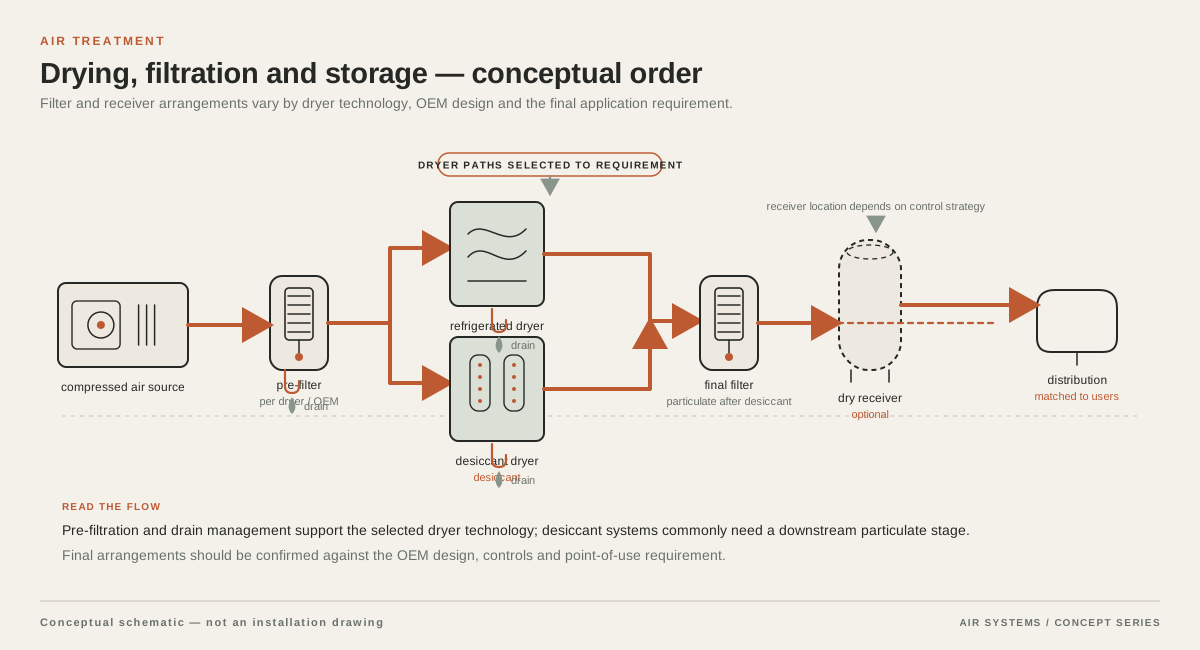
DETAILED SELECTION & OPERATION
When desiccant drying is appropriate
A desiccant dryer is usually considered when moisture must be controlled below the practical pressure-dew-point range of a refrigerated dryer. Typical decision triggers include outdoor or unheated distribution, cold production areas, instrumentation exposed to low temperatures, moisture-sensitive powders or materials, and process air with a documented low-dew-point requirement. The requirement should be stated at a location and operating pressure, not as a vague request for dry air. Pressure dew point is the temperature at which water would begin to condense at the stated compressed-air pressure.
Drying beyond the end-use requirement adds capital, pressure-drop, purge, heater, fan, and maintenance burden. DOE guidance says to dry only as much as the equipment and end use require. Compare moisture risk with the energy and lifecycle effect of the requested dew point.
- Appropriate candidates: cold-area distribution, moisture-sensitive processes, and equipment with a documented low pressure dew point requirement.
- Questionable candidates: general plant air where a moderate dew point is adequate and no freezing or condensation risk exists.
- Do not specify a low dew point merely because a catalogue category exists; identify the end-use limit first.
How regenerative adsorption works
Regenerative desiccant dryers commonly use two vessels. One tower dries the incoming compressed air as moisture is adsorbed in the desiccant pores while the other tower is regenerated. The towers then change roles through an automatic sequence. Regeneration can reduce pressure and pass previously dried purge air through the bed, add heat to the bed or purge stream, or use a blower-assisted arrangement. The exact cycle, valve sequence, switching logic, and desiccant loading are configuration matters to be confirmed by the supplier.
The DOE compressed air sourcebook describes silica gel, activated alumina, and molecular sieves as desiccant types and advises using the type specified by the manufacturer. Do not substitute a desiccant based only on a name or advertised dew point. Bed depth, particle size, inlet contamination, liquid-water carryover, and regeneration conditions all affect reliable operation.
Configuration and operating tradeoffs
Heatless pressure-swing arrangements are mechanically straightforward but consume part of the dried air stream for regeneration. Heated arrangements can reduce purge demand by supplying heat, but heater power, controls, warm-up behaviour, ventilation, and safety provisions must be included in the comparison. Blower-assisted designs may avoid using product air for some regeneration steps, but they introduce blower power, noise, filters, and additional components. These are engineering options, not fixed product characteristics of this website.
The DOE sourcebook gives an illustrative range of 10–18% of dryer rating for purge air in pressure-swing regenerative dryers and notes that the range depends on dryer type. It also states that inlet temperature, inlet pressure, and ambient conditions affect rated capacity. Treat those figures as source guidance rather than a quotation value. Request the supplier’s purge or electrical consumption at the actual design conditions and stated dew point.
| Configuration route | Potential advantage | Tradeoff to verify | RFQ evidence |
|---|---|---|---|
| Heatless purge regeneration | No regeneration heater required | Product-air loss and associated compressor energy | Purge percentage or flow, cycle, and pressure-drop test basis |
| Heated regeneration | May reduce purge requirement | Heater energy, controls, ventilation, and warm-up sequence | Heater input, purge flow, outlet dew point, and operating sequence |
| Blower-assisted regeneration | May limit use of dried product air | Blower power, noise, filtration, and additional maintenance | Blower rating, regeneration air path, and total package power |
| Dew-point-controlled switching | Can adapt regeneration to measured conditions | Sensor location, control logic, and response during transients | Sensor specification, alarm logic, and demonstrated control range |
Size from real inlet conditions, not nominal flow alone
A dryer’s nominal capacity is meaningful only with its rating basis. Provide the maximum, normal, and minimum inlet flow; inlet pressure; inlet compressed-air temperature; ambient temperature; and the required outlet pressure dew point. Include compressor discharge cooling, aftercooler performance, condensate separation, and any expected liquid-water carryover. A higher inlet temperature or lower inlet pressure can reduce available capacity, so a unit selected from a standard flow line without correction factors may not meet its target in service.
State flow using a defined reference. FAD, actual cubic metres per minute, standard cubic feet per minute, and normalized cubic metres per hour are not interchangeable unless pressure, temperature, humidity, and reference conditions are written down. Ask the supplier to show corrected capacity at the design point and worst credible combination of flow, pressure, temperature, and dew point.
- Normal and peak flow, including simultaneous users and future allowance.
- Minimum and maximum inlet pressure and compressed-air temperature.
- Required pressure dew point, measurement location, and allowable tolerance.
- Flow reference conditions and the correction factors used in the offer.
- Maximum permitted pressure drop at clean and expected service conditions.
Integrate the dryer with the treatment train
A desiccant dryer should not be treated as a stand-alone moisture cure. Upstream aftercooling and a reliable condensate separator reduce the liquid load entering the adsorption beds. Coalescing or particulate filtration may be needed to protect the desiccant and downstream process, but filters do not replace drying. Confirm the filter grades, drain arrangements, bypass philosophy, and differential-pressure monitoring with the selected supplier. A prefilter or afterfilter may be standard or optional depending on the proposed package and the air-quality requirement.
Install where ambient temperature, ventilation, access, and drainage suit the configuration. Assess any isolation or bypass because an open bypass can defeat moisture control. Heated and blower-assisted arrangements need space and electrical provisions. Size pipework for acceptable pressure drop and protect the outlet from re-condensation.
Separate dew point from air purity
A low pressure dew point addresses water vapour. It does not, by itself, prove that the air is free of oil, particles, vapour, microorganisms, or other contaminants. ISO 8573-1:2010 defines purity classes for particles, water, and oil independent of where the air is specified or measured, and it also identifies gaseous and microbiological contaminants. Therefore write a complete air-quality requirement when the end use needs one, including the class, test method, sampling point, and acceptance basis.
Do not describe a desiccant dryer as food-safe, sterile, oil-free, or compliant with a particular purity class without evidence for the complete installed system. Compressor technology, intake air, lubricants, separators, filters, pipework, drains, and point-of-use treatment can all affect delivered air. If the requirement is only moisture control, say so. If purity is critical, request test reports or a defined validation plan rather than relying on a component label.
Maintenance and failure prevention
Maintenance depends on the dryer design, desiccant, ambient conditions, duty, and inlet contamination. The supplier should identify inspection points for valves, controls, dew-point sensors, filters, drains, heaters, blowers, and desiccant. A copied interval is not universal. Trend outlet dew point and pressure drop, check separation and drains, and request alarm priorities, bypass instructions, spare-part lead times, and return-to-service procedures.
RFQ criteria and data to confirm
A useful RFQ asks for a performance basis rather than only a dryer size. Identify the process, point of use, operating hours, load profile, and consequences of wet air. Require the bidder to state assumptions and separate standard configuration from options subject to confirmation. This makes heatless, heated, and blower-assisted offers comparable without implying availability from this site.
Ask for corrected capacity, outlet pressure dew point, purge or total electrical consumption, pressure drop, inlet and ambient limits, controls, alarms, dimensions, connections, and service access. Request the test method and reference conditions for each value, plus warranty, commissioning, consumables, desiccant replacement, and local service arrangements.
- End use, required pressure dew point, sampling location, and moisture consequence.
- Normal, peak, minimum, and future flow with explicit FAD/SCFM/Nm³ reference conditions.
- Inlet pressure range, inlet temperature range, ambient conditions, and liquid-water protection.
- Preferred regeneration approach and acceptable purge, heater, blower, and total power burden.
- Desiccant type, valve and sensor service strategy, consumables, warranty, commissioning, and support.
SELECTION & OPERATION
Frequently asked questions
Are desiccant air dryers always better than refrigerated dryers?
No. Desiccant dryers are appropriate when the required pressure dew point or operating environment demands adsorption drying. If a moderate dew point is sufficient, a refrigerated dryer may have a lower overall energy and maintenance burden. Compare the actual end-use requirement, coldest pipe temperature, flow profile, pressure drop, purge or heater energy, and lifecycle cost.
What pressure dew point should I specify?
Specify the lowest dew point required by the coldest relevant equipment or process location, with its pressure and measurement point. Do not select a universal value. A supplier should confirm the achieved pressure dew point at stated inlet flow, pressure, temperature, ambient conditions, and cycle settings.
How much purge air does a heatless desiccant dryer use?
The amount is configuration- and condition-dependent. DOE guidance describes a pressure-swing regenerative range of about 10–18% of dryer rating, but that is not a quotation guarantee. Request the supplier’s purge flow or percentage at your design conditions and include its compressor-energy effect in the comparison.
Does a desiccant dryer make compressed air oil-free or food-safe?
No. It primarily controls water vapour. Air purity depends on the entire compressor, treatment, distribution, and point-of-use system. For critical uses, specify the relevant ISO 8573-1 classes and verification method, and obtain evidence for the complete installed arrangement rather than assuming a dryer component provides food safety or zero contamination.
Technical references
- Improving Compressed Air System Performance ↗
Desiccant adsorption and regenerative tower operation; desiccant types; dryer rating sensitivity to inlet pressure, inlet temperature, and ambient conditions; illustrative purge-air and pressure-drop/energy tradeoffs; guidance to dry only as much as the end use requires.
- ISO 8573-1:2010 - Compressed air — Part 1: Contaminants and purity classes ↗
The scope of compressed-air purity classes for particles, water, and oil, plus identification of gaseous and microbiological contaminants independent of the location where air is specified or measured.