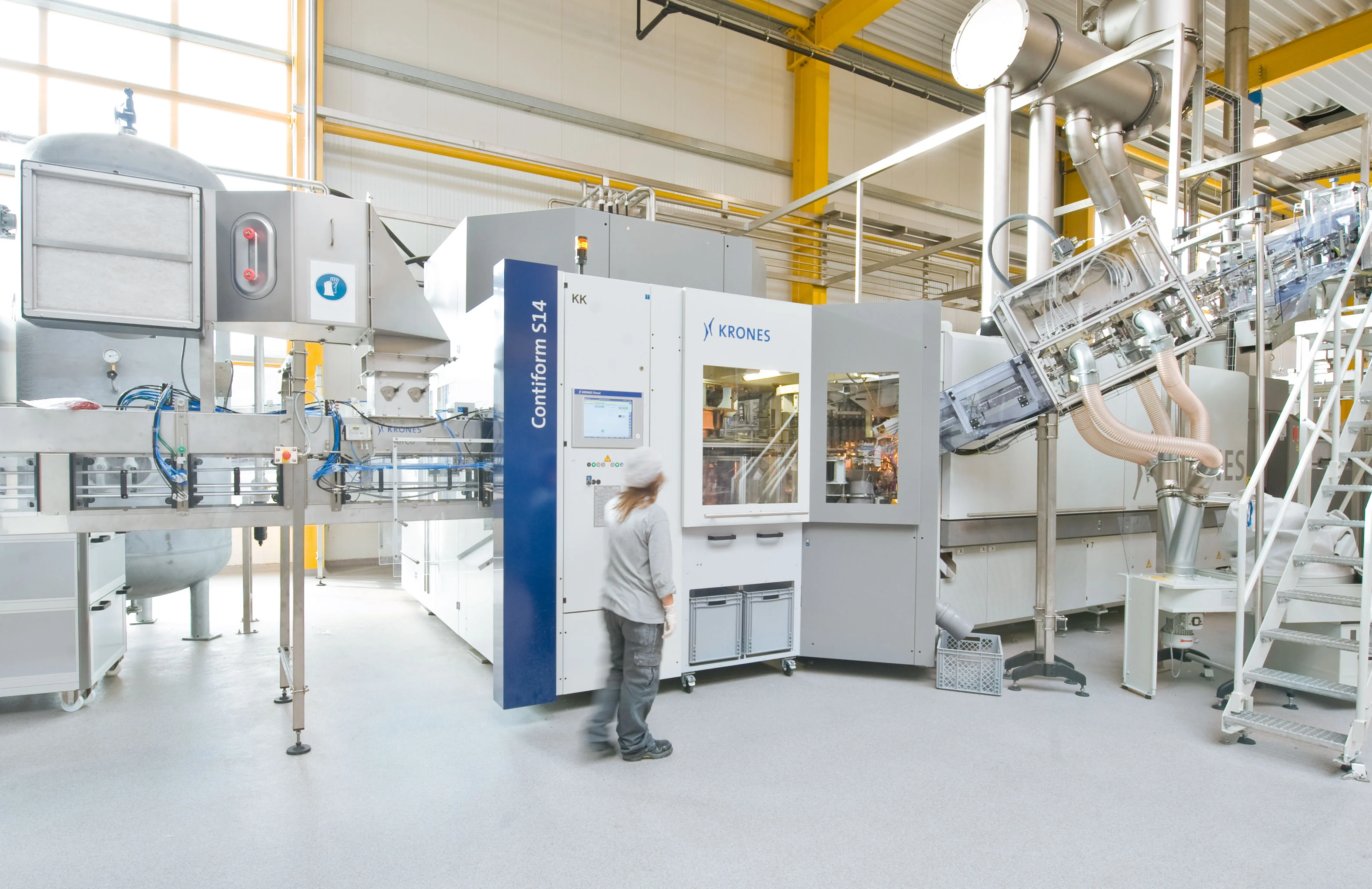
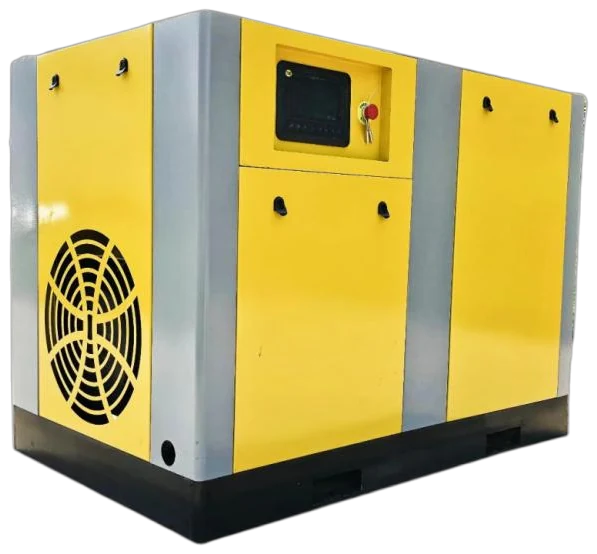
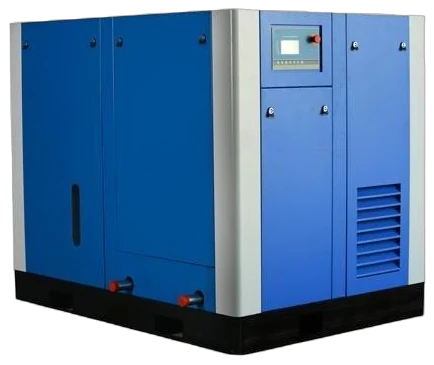
Complete compressed air system.
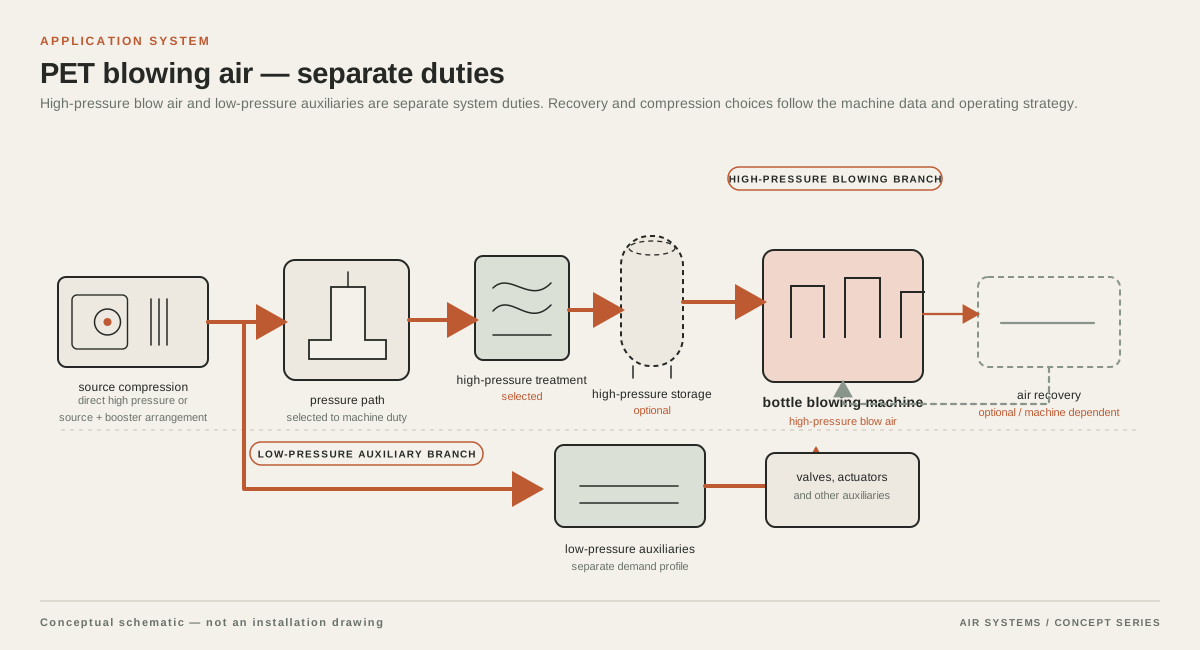
Combine compression, cooling, treatment, storage and distribution at the required pressure and point-of-use air quality. The layout below explains the system interfaces; it is not a photograph of an installed project.
DETAILED SELECTION & OPERATION
High-pressure blow air and low-pressure auxiliaries are different duties
In a stretch-blow process, a heated PET preform is positioned in a mold, stretched with a rod, and expanded by a short high-pressure air event. The blow circuit must receive the OEM-required pressure at the machine connection while the cycle is running. Around 25 bar(g) is often cited as an example, but the actual requirement depends on material and production speed; it is not a universal PET setpoint.
The line also has lower-pressure users. Plant air can operate preform feed, stretch-rod and clamp actuators, grippers, conveyors, controls, and related packaging devices. Their flow profile can be continuous, intermittent, or shared with other equipment. Treating this branch as part of the blow demand conceals simultaneous loads and can make a low-pressure service follow every high-pressure blow pulse. List both duties separately before the package is sized.
- Primary blow air: high-pressure air delivered at the molder inlet to the OEM pressure, flow reference, cycle, and quality requirement.
- Auxiliary plant air: lower-pressure air for handling, pneumatic actuation, controls, and line equipment according to the equipment list.
- Interface equipment: pressure-rated storage, treatment, non-return protection, isolation, piping, and monitoring designed for each pressure zone.
Use the high-pressure catalogue as a source-selection basis
The authorized electric medium/high-pressure selection manual records catalogue model entries in /20, /30, and /40 pressure groups. Selected examples are shown in the catalogue table for this page. The table keeps the source designation of nominal volumetric flow in m³/min; it does not relabel the value as FAD. Motor rated power is a motor figure, not a package electrical-input claim.
The manual also records a lubricating-oil field for the selected high-pressure series. That is why a high-pressure source must not be described as oil-free or as automatically suitable for every food or beverage packaging application. The selected compression path, treatment train, material controls, sampling plan, and end-user acceptance criteria belong in the final project specification.
Size blow air for cycle peaks, storage, and recovery
PET blowing is a cyclic load. Record blow duration, cycle frequency, cavities in operation, number of machines, production rate, start-up, idle, and changeover states. The design profile needs maximum instantaneous demand, average demand over a representative interval, and the time available for the receiver and compressor to recover. Ask for separate values for the current connected load and the intended expansion case.
A receiver buffers a short event; it does not create air. Its volume, allowable pressure band, operating pressure, piping arrangement, and control deadband must be stated with the demand assumptions. High-pressure storage is also a pressure-vessel duty. The responsible engineer should confirm jurisdiction, inspection route, relief-device sizing, and installation requirements before equipment is ordered.
Trend data or a temporary flow meter is valuable where it can be installed. A nameplate flow can omit leaks, blow-off, air recovery, idle air, and production changes. The final proposal should state how the package regains required pressure before the next event and what alarm or response applies if recovery is not achieved.
Match the air system to the bottle and OEM machine
Do not select a PET air system from bottle volume or a nominal pressure alone. Request the machine's required pressure at the inlet, minimum operating pressure, permitted pressure variation, maximum and average consumption per cycle, flow-reference basis, connection details, and auxiliary-air requirements. Confirm whether each value is FAD, standard flow, actual flow, or another stated basis, with its reference temperature and pressure.
Attach the preform resin and grade, preform mass and dimensions, bottle volume and geometry, wall target, mold cycle, cavities, planned output, and bottle-quality requirements. These inputs can change the high-pressure blow event even where the machine has the same nominal pressure class. A compressor discharge gauge is not proof that the blow valve receives the required condition; account for treatment, controls, valves, headers, hoses, and machine piping.
PET bottle blowing RFQ data to provide
A useful quotation compares the same delivered condition at the named machine connection. Attach the blow-molding machine data sheet, bottle and preform information, line layout, production schedule, present and future machines, utilities, and quality requirement. Require every quotation to list its assumptions and exclusions so that unresolved inputs remain visible.
Request a performance schedule for normal production, maximum production, start-up, idle, and future expansion. It should identify pressure, flow and its reference, temperature basis, inlet conditions, simultaneous loads, pressure loss, recovery time, cooling duty, treatment scope, and test method. For a booster route, add the proven lower-pressure source condition and its reserve during every blow cycle.
- Bottle and process: resin, preform, bottle geometry, cavities, wall target, mold cycle, production rate, and quality tolerances.
- Machine: OEM blow-pressure range, minimum inlet pressure, air volume per cycle, flow basis, cycle frequency, connection size, and auxiliary-air data.
- Plant: existing source capacity, measured pressure and flow, receiver capacity, electrical and cooling utilities, ambient conditions, altitude, layout, and expansion plan.
- Quality: pressure dew point, particle and oil or vapor limits where relevant, sampling point, material restrictions, condensate route, and validation plan.
- Delivery: required configuration boundary, redundancy expectation, commissioning acceptance, documentation, spares, service terms, and applicable statutory obligations.
SELECTION & OPERATION
Frequently asked questions
Is 25 bar(g) the standard pressure for PET bottle blowing?
No. Around 25 bar(g) is an example cited for PET stretch blowing, and the required pressure depends on material and production speed. The molder OEM's machine-inlet pressure, flow basis, cycle, and minimum permitted condition control the system design.
What high-pressure equipment can be configured for PET blowing?
A dedicated high-pressure source can be configured around the authorized electric medium/high-pressure compressor catalogue, with pressure-rated cooling, receiver storage, treatment, controls, and distribution. The manual contains /20, /30, and /40 catalogue pressure groups. The final compressor model, treatment scope, and machine-inlet performance are selected from the RFQ duty, not from the photograph or pressure label alone.
Should a PET line use a dedicated high-pressure compressor or a booster?
A dedicated source suits a blow-air circuit that needs its own high-pressure supply. A booster can be evaluated when the existing lower-pressure system has verified inlet pressure, flow, storage, and recovery capacity while auxiliaries are operating. Compare both routes at the same machine connection; the booster itself must be specified for the project because this page does not identify a substantiated booster model.
Can one air system supply blow air and machine auxiliaries?
It can be engineered, but high-pressure blow air and lower-pressure auxiliaries should first be documented as separate duties. Use pressure zones, regulation, storage, and non-return protection only where the machine OEM and system design approve them. Verify simultaneous demand and point-of-use pressure rather than relying on the compressor discharge gauge.
Does a high-pressure compressor automatically meet food or beverage packaging requirements?
No. The selected high-pressure catalogue series includes a lubricating-oil field and is not presented as oil-free. Food, beverage, and other sensitive packaging applications require defined delivered-air limits, pressure-rated treatment, materials controls, sampling, and end-user validation at the point of use.
Technical references
- Authorized Dezhou YITong electric medium/high-pressure selection manual ↗
Authorized supplier material held by Airworks: pages 3 and 5–8 provide the high-pressure compressor product references, model entries, catalogue nominal volumetric-flow designation, pressure groups, motor fields, and lubricating-oil fields used for this page.
- The Crucial Role of Compressed Air in the PET Blowing Process ↗
PET stretch-blow process context and the qualified example of around 25 bar(g), which the source says depends on material and production speed; it also discusses high-pressure compressors or boosters.
- PET Blow Molding — high-pressure air dryer application ↗
Separate lower-pressure plant air and high-pressure blow air, pressure-rated treatment, downstream drying after compression cooling, and the need to consider water and oil risk at the bottle.
- PET Bottle Blowing Efficiency ↗
PET systems can have multiple pressure requirements and fast demand swings; storage, controls, pressure drop, and an audit of the actual system profile matter to source selection.
- Contiform S14 stretch blow-molding machine photograph ↗
Representative real PET stretch blow-molding machine image used in the page media brief under CC BY-SA 3.0; it is not a Dezhou YITong installation, supplied machine, or project reference.