Complete compressed air system.
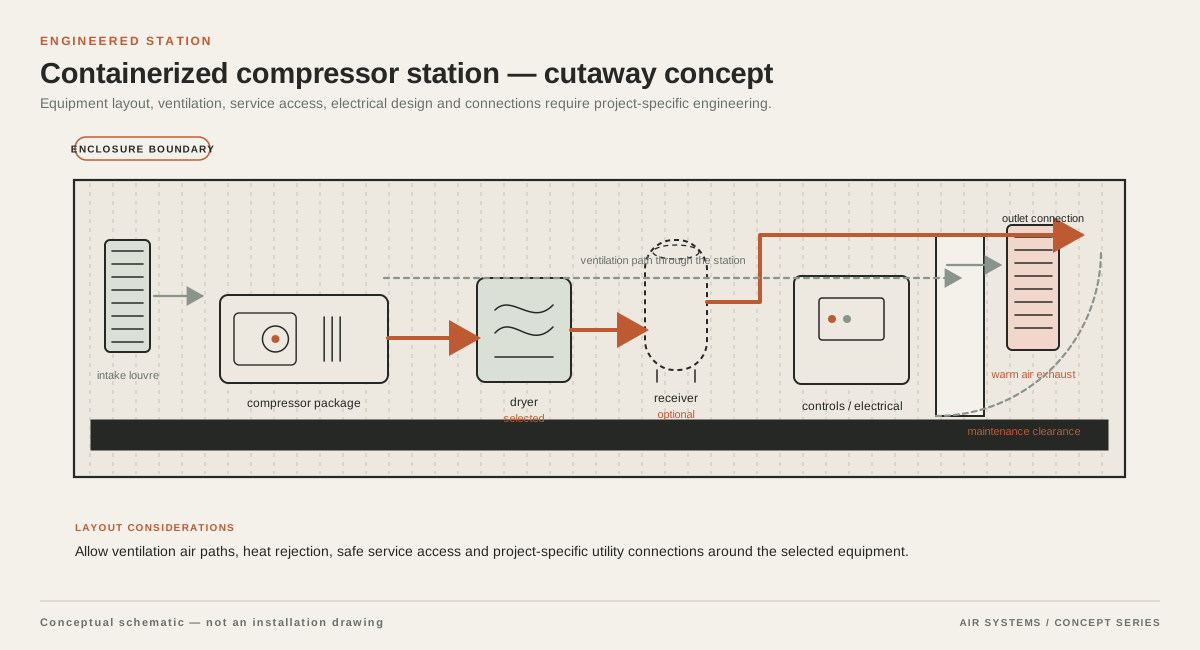
Combine compression, cooling, treatment, storage and distribution at the required pressure and point-of-use air quality. The layout below explains the system interfaces; it is not a photograph of an installed project.
DETAILED SELECTION & OPERATION
When containerization is a sensible choice
Containerization is most useful when a project needs a packaged utility in a remote or changing location, when civil construction time is limited, or when a repeatable module will be deployed at several sites. A weather-resistant enclosure can consolidate equipment and reduce the amount of field assembly, while a defined lifting and connection plan can make relocation possible. These benefits depend on transport dimensions, ground conditions, access for cranes or forklifts, and a local service strategy. A module should be evaluated as a system boundary, not selected from a compressor nameplate alone.
It may be a poor fit where the site has severe heat, corrosive dust, flood exposure, hazardous-area requirements, restricted lifting access, or insufficient room for maintenance removal. A conventional compressor room can offer more working space and easier ventilation changes. For a small indoor installation, a packaged skid may be simpler than a full enclosure. For a high-demand plant, several modules may improve redundancy, but they also add controls, interconnecting pipework, and synchronization decisions that must be engineered.
- Appropriate use cases include remote utilities, temporary production expansions, phased capacity, and sites where a separate compressor room is impractical.
- Reconsider the concept if the container cannot provide safe access, heat rejection, drainage, lifting clearance, or code-compliant pressure-vessel arrangements.
- Treat the enclosure as a project design element; it is not evidence that a particular compressor, dryer, or certification is included.
Define the air duty before choosing the package
Start with measured or defensible demand rather than the volume of the container. Record required flow at the stated reference conditions, working pressure at the point of use, operating hours, start-up demand, minimum and maximum ambient temperature, altitude, and the consequences of low pressure. Identify whether demand is steady, cyclic, or dominated by short peaks. A receiver and control strategy may manage intermittent demand, but storage does not create compressor capacity for a sustained load. State FAD, CFM, or normalized flow bases explicitly and ask suppliers to show the same reference conditions in their offer.
Separate pressure requirements by user. A high-pressure process, a plant header, and a low-pressure instrument branch may need different pressure levels and treatment. Do not add an arbitrary pressure margin without checking pressure drop, controls, treatment losses, and point-of-use requirements. The compressor discharge pressure, receiver pressure, and usable pressure at the machine connection are different design values.
Choose the package boundary deliberately
A containerized station may contain one or more compressors, a common discharge header, aftercoolers, moisture separation, dryers, filters, receivers, condensate handling, electrical distribution, a controller, and monitoring. Some projects place the receiver outside to reduce enclosure weight or improve access; others include it inside when the vessel, drains, and inspection clearances can be accommodated. Ask for a marked boundary drawing that identifies what is factory assembled, what is shipped loose, and what the site contractor must connect.
Standard and optional configuration items are subject to supplier confirmation. Typical items to compare include fixed-speed or variable-speed control, duty/standby sequencing, inlet filtration, refrigerated or desiccant drying, coalescing and particulate filtration, heat recovery provisions, remote telemetry, acoustic treatment, fire detection, winterization, and redundant ventilation. These are comparison criteria, not specifications offered by this site. A component certificate also does not establish approval of the complete assembled station.
| Area | Compare or request | Why it matters |
|---|---|---|
| Compression | Technology, quantity, control mode, duty/standby philosophy | Matches the load profile and maintenance strategy without assuming a supplier model. |
| Air quality | Dryer type, filter grades, drain method, target quality class | Treatment must match the process and be verified at the point of use. |
| Enclosure | Weather rating, insulation, access doors, lifting points, noise approach | Determines transport, environmental protection, service access, and site interfaces. |
| Utilities | Electrical supply, heat rejection, ventilation, drains, communications | Prevents a packaged unit from failing at the boundary between vendor and site. |
| Evidence | Drawings, manuals, test records, code documents, exclusions | Allows the buyer to distinguish demonstrated compliance from proposed configuration. |
Design ventilation and heat rejection as a system
Compression releases heat into the enclosure unless it is intentionally ducted or otherwise rejected. The ventilation concept should account for compressor cooling air, motor and electrical losses, dryer heat, solar gain, winter conditions, and any recirculation path. CAGI guidance emphasizes arranging inlet grids and ventilation fans to avoid recirculating warm cooling air. Therefore, request an airflow and heat-load basis, not simply a fan count. Confirm whether fans are included, how they are controlled, what happens on fan failure, and how high ambient temperature affects the proposed operating envelope.
Locate air intakes away from vehicle exhaust, process emissions, dust, spray, and other contaminants. Provide a route for hot exhaust air that does not discharge toward an intake or occupied area. Louvers, filters, acoustic attenuators, dampers, heaters, and weather hoods can change pressure loss and airflow. The supplier should state assumptions for ambient temperature, altitude, solar exposure, and any derating. Do not promise rated output or enclosure temperature until these inputs and the final ventilation design are confirmed.
Coordinate treatment, storage, and condensate
Aftercooling and moisture separation affect the load presented to dryers and filters. A dryer selection should use actual inlet pressure, flow, temperature, ambient conditions, and required pressure dew point. Filters introduce pressure loss and need a service and differential-pressure plan. If the process requires a defined air-quality class, specify the class and the sampling or verification method at the relevant point of use; an oil-free compression process alone is not a blanket guarantee of contaminant-free air.
Receivers can damp pressure fluctuations and support control stability, but their size and location must reflect the demand cycle, allowable pressure band, and safety requirements. In the United States, OSHA's air-receiver rule requires accessible drains, a visible pressure gauge, and one or more spring-loaded safety valves with relieving capacity tied to the vessel's allowable working pressure. Local pressure-vessel law may differ, so the RFQ must identify the governing jurisdiction and inspection responsibility. Condensate discharge, oil-water separation where applicable, and freeze protection must be resolved before shipment.
Plan the site interfaces before delivery
A containerized station still needs a prepared foundation, level and bearing information, anchoring, access for delivery and lifting, electrical protection, earthing, compressed-air tie-in, drains, ventilation clearances, and safe working space. Request overall dimensions, shipping mass, center of gravity or lifting points, lifting restrictions, door swing, maintenance pull space, and the minimum clearances needed to remove major components. Confirm whether the roof, walls, or floor are intended to carry loads or support external equipment.
Define the connection schedule in plain language. It should show incoming voltage and fault level, cable entry, isolation, controls network, instrument air or service air needs, discharge pipe size and material, condensate route, drain termination, and any external cooling or exhaust duct. The supplier should identify field welds, field cable terminations, commissioning utilities, preservation requirements, and weather sealing. Site acceptance should include functional checks under agreed operating conditions rather than only a visual inspection.
Make access and maintenance part of the enclosure design
Compact packaging can conceal a maintenance problem. Require access to oil or lubricant service points where relevant, intake and control filters, separators, belts or couplings where applicable, dryer components, drains, safety devices, electrical panels, and instrumentation. The layout should allow isolation, depressurization, lockout/tagout, and safe removal of service items without climbing over hot or pressurized equipment. Maintenance intervals must remain dependent on the selected OEM, ambient conditions, contamination, duty, and the final operating data; this page does not assign universal schedules.
Ask how alarms are presented locally and remotely, including high temperature, ventilation failure, high pressure, drain fault, dew-point deviation where monitored, and emergency stop status. Confirm noise limits at specified locations and operating modes rather than accepting a generic acoustic claim. If the site is hazardous, corrosive, or exposed to combustible dust or gas, provide the classification and request evidence for the whole assembly. Do not infer hazardous-area approval from an individual component label.
RFQ information to confirm before quotation
A useful RFQ lets suppliers price the same boundary and identify exclusions. Attach a site plan, utility schedule, demand profile, process air-quality requirement, environmental data, and the delivery route. Ask each bidder to return a general arrangement, P&ID, heat and ventilation basis, electrical single-line diagram, control narrative, interface list, foundation loads, shipping and lifting data, commissioning plan, documentation list, and a schedule of deviations. Require all performance values to state reference conditions and test method.
Use the following checklist as a minimum, then have the responsible engineer and local authority add project-specific requirements:
- Required flow, pressure, reference conditions, demand cycle, start-up peak, future expansion, and allowable pressure drop.
- Ambient temperature range, altitude, humidity, dust or corrosive exposure, solar load, noise limit, and hazardous-area classification if applicable.
- Compressor technology and quantity, sequencing philosophy, dryer and filter target, receiver location, drains, condensate treatment, and monitoring points.
- Electrical voltage, frequency, fault level, earthing, cable entry, communications, emergency stop, and local code or inspection requirements.
- Transport dimensions and mass, lifting points, foundation and anchoring data, maintenance clearances, spare parts, training, warranty terms, and exclusions.
SELECTION & OPERATION
Frequently asked questions
Is a containerized compressor station automatically a complete turnkey system?
No. The enclosure may contain a defined package, but the quotation must state whether compressors, dryers, filters, receiver, drains, controls, ventilation, electrical equipment, fire provisions, ductwork, foundations, and site connections are included. Request a boundary drawing and exclusions list before comparing prices.
Can a standard shipping container be used as a compressor room?
Not without engineering review. Compressor heat, ventilation airflow, access, noise, fire and electrical provisions, pressure-vessel placement, drainage, structural loading, and local code requirements can differ from a cargo container's original purpose. A supplier must confirm the enclosure design and operating envelope for the actual duty and environment.
Should the receiver and dryer be inside the container?
It depends on mass, available clearances, ambient conditions, inspection access, pressure-vessel rules, treatment requirements, and the site layout. Keeping equipment inside can shorten field pipework, while locating a receiver or heat-producing equipment outside may simplify ventilation and maintenance. Compare both arrangements using the same defined system boundary.
What technical documents should accompany a quotation?
Request a general arrangement, P&ID, equipment schedule, performance basis with reference conditions, ventilation and heat-load calculation, electrical data, control narrative, lifting and foundation information, connection schedule, compliance evidence, commissioning plan, manuals, and a clear list of supplier and site responsibilities.
Technical references
- Improving Compressed Air System Performance: A Sourcebook for Industry ↗
System-level planning, supply-side and demand-side relationships, and the need to evaluate compressed-air equipment as an integrated system.
- CAGI Air Compressor Handbook ↗
General compressor installation considerations, including ventilation, ambient conditions, and avoiding recirculation of cooling air.
- OSHA 1910.169 Air receivers ↗
U.S. requirements stated on the source page for receiver accessibility, drains, visible pressure gauges, and spring-loaded safety valves; local jurisdiction must be checked separately.