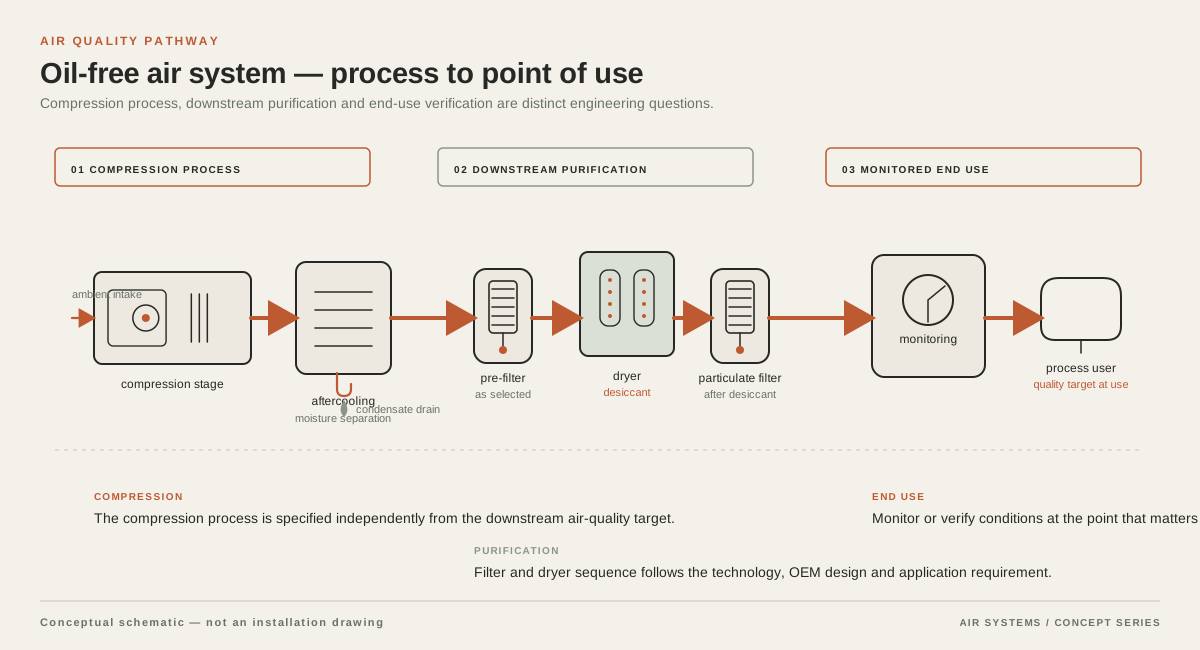
Complete compressed air system.
Combine compression, cooling, treatment, storage and distribution at the required pressure and point-of-use air quality. The layout below explains the system interfaces; it is not a photograph of an installed project.
DETAILED SELECTION & OPERATION
Classify every air use by contact risk
Start by listing every outlet and documenting what the air can touch. Direct contact includes air that enters a product, touches an exposed ingredient, or contacts an internal product surface. Indirect contact includes air that can reach food through a package, surface, or process step without being intentionally blown into the product. Non-contact service air may operate a cylinder or valve with no credible path to food, but it can still create a housekeeping or equipment risk if condensate, lubricant, or particles migrate. The site HACCP or preventive-control team should approve the classification and the consequence of loss of control.
Do not use the phrase food-grade air as a substitute for a documented endpoint. The required control depends on the product, exposure time, temperature, sanitation method, packaging state, and applicable customer or jurisdictional rules. A dry-air requirement for a pneumatic actuator is not automatically the right requirement for air used to aerate a beverage or blow an open container. Separate specifications by use zone where necessary, and identify the highest-risk outlet rather than applying one unexamined plant-wide assumption.
- Direct contact: define the target contaminant limits, sampling point, test method, and release decision before procurement.
- Indirect contact: assess transfer paths, package integrity, blow-off direction, and whether a point-of-use safeguard is needed.
- Non-contact service: still control water, oil, and particles that could damage equipment or migrate through leaks and drains.
- Sanitation and washdown zones: specify materials, drainage, enclosure, and restart controls separately from ordinary dry-room air.
Define the purity endpoint instead of buying a label
ISO 8573-1:2010 classifies compressed-air purity with respect to particles, water, and oil, and also identifies gaseous and microbiological contaminants. The class is meaningful only when the buyer states the relevant contaminant categories, the measurement location, and the test or evidence expected. A compressor described as oil-free concerns the compression process; it does not by itself prove that the delivered air is free of water, particles, vapour, microorganisms, or contamination introduced downstream. Conversely, an oil-injected compressor may be unsuitable for a particular contact risk even when treatment is proposed. Confirm the complete air path and the required endpoint with the quality owner.
For a direct-contact use, request a written purity specification at the point where air meets the product, not only at the compressor discharge. State whether the requirement concerns liquid oil, oil aerosol, oil vapour, particles, water, and microbiological control. Ask how sampling avoids a misleading result caused by a clean upstream sample, a dirty branch, a dead leg, or a filter that has been bypassed. Do not describe an assembly as ISO Class 0 or food-safe unless the supplier provides evidence for the specified system, test conditions, and location; a component certificate is not assembly approval.
| Air use | Engineering comparison criterion | RFQ evidence to request |
|---|---|---|
| Direct product or ingredient contact | Treatment train, hygienic design, point-of-use protection, stable flow and verified outlet quality | Target contaminant limits, test method, sampling plan, certificates or reports applicable to the complete installation |
| Indirect contact or open-package vicinity | Risk of migration, outlet location, filtration redundancy, drainage and cleanability | Contact classification, outlet arrangement, filter grades, drain type, monitoring and corrective-action plan |
| Non-contact pneumatic service | Pressure stability, water removal, equipment protection and lifecycle maintenance | Required pressure/flow, dew point, allowable oil and particle level, service access and alarm requirements |
Match compression and treatment to the process
A food plant may use a rotary screw, reciprocating piston, scroll, or another compressor configuration. The technology choice should follow the duty profile, required pressure, flow variation, room conditions, noise limits, maintenance capability, and purity strategy. Do not select a compressor only because its brochure uses the term oil-free, and do not assume a single central treatment train is appropriate for every department. A central system can simplify monitoring, while separated high-risk branches can make point-of-use control and fault isolation clearer. Suppliers should state what is standard and what is optional, subject to confirmation for the actual duty and installation.
Treatment normally has a relationship with the compressor, receiver, dryer, filters, drains, distribution piping, and point-of-use devices. The order and selection depend on the intended air quality and operating conditions. Include condensate management and drain failure alarms in the design conversation; a filter without a reliable drain or differential-pressure indication can become a hidden restriction or contamination path. A sterile or microbiological control step, if required by the validated process, must be specified and verified as part of the complete system rather than inferred from a compressor package.
- Compressor: compare compression process, turndown, duty cycle, inlet conditions, cooling arrangement, and service requirements.
- Receiver: assess buffer volume, wet or dry placement, drain strategy, pressure rating, inspection duties, and local vessel rules.
- Dryer and filters: size for actual inlet flow, pressure, temperature, and pressure drop; define bypass prevention and alarms.
- Point of use: consider final filtration, hygienic connections, sampling ports, regulator stability, and protection from washdown.
- Controls: identify high-temperature, high-dew-point, differential-pressure, drain-failure, and purity-monitoring actions where relevant.
Size for production peaks, not an average guess
Build a demand schedule by production state. Record normal flow, simultaneous users, short blow-off events, start-up demand, cleaning demand, packaging cycles, and planned expansion. Measure or estimate flow at a stated reference condition and state whether the value is free air delivery, actual volumetric flow, standard flow, or normalized flow. The receiving supplier should reconcile the stated flow basis with its quoted capacity. A nominal compressor capacity that looks adequate at the plant header may fail at a distant filler or blow nozzle after dryer, filter, regulator, hose, and distribution pressure losses.
Specify the minimum pressure at each critical point of use and the maximum allowable pressure drop between the measurement location and that outlet. Include inlet air temperature, ambient temperature, altitude, cooling-water conditions if applicable, and the worst production state. If the plant has intermittent demand, compare storage and control strategies rather than automatically oversizing the compressor. A receiver may smooth short peaks, but it does not remove the need to calculate recovery time, compressor response, treatment capacity, and downstream pressure stability.
Design the room, piping, and outlets for hygiene
Locate the compressor intake away from vehicle exhaust, chemical vapours, dust, waste handling, and other sources that could enter the air stream. Confirm room ventilation, heat rejection, access for service, and protection from washdown. Keep condensate and drain discharge managed in accordance with site and local requirements. The piping design should limit low points and dead legs, provide accessible isolation, and avoid materials or sealants that are incompatible with the air quality, cleaning chemicals, or temperature. The final arrangement should be reviewed by engineering, maintenance, and quality rather than accepted from a generic layout.
At production outlets, make the clean side identifiable and protect it from accidental cross-connection. Provide sampling ports at representative points, including the most remote or highest-risk branch when appropriate. Consider hygienic fittings, capped connections, sloped sections, drainability, and the effect of flexible hoses. If air is used near an open product, orient the outlet and exhaust so that the air path does not carry dust or condensate toward food. Document commissioning cleanliness and the conditions under which the line may be released for production.
Plan verification and maintenance as one control
A purity requirement is incomplete without a verification plan. Define which contaminants are tested, where samples are taken, the laboratory or method, acceptance limits, frequency, and the action when a result fails. SQF guidance states that food operations should regularly monitor compressed air used in the process so it is appropriate and does not become a contamination source. Use that principle with the site risk assessment; do not invent a universal test interval or assume that a new filter remains effective indefinitely.
Maintenance intervals depend on the OEM instructions, ambient conditions, operating hours, loading, inlet quality, and duty. The RFQ should request a maintenance matrix for compressor elements, separators, filters, dryers, drains, sensors, and sampling equipment. Track differential pressure, dew point or other selected indicators, drain operation, alarm history, and changes in product or production rate. A failed drain, saturated desiccant, damaged seal, unrecorded bypass, or filter change without post-maintenance verification can invalidate an otherwise well-designed treatment train.
RFQ information for a food and beverage air system
Give suppliers a use-by-use schedule instead of one plant-wide flow number. Include product and ingredient exposure, open or closed packaging, contact duration, sanitation regime, operating hours, ambient conditions, and the consequence of an out-of-specification result. Request a line diagram showing compressor, receiver, dryer, filters, drains, branches, sampling points, and any bypass. Ask suppliers to mark standard, optional, and customer-supplied items. Every quoted performance value should state its reference conditions, measurement location, tolerance, and whether it is guaranteed or only an engineering estimate.
Ask for commissioning and handover deliverables, not just equipment pricing. These may include pressure and flow test records, dew-point results, filter data, drain and alarm tests, material information, maintenance instructions, recommended spares, calibration records, and a proposed verification schedule. If direct contact is involved, require the supplier to identify the evidence that applies to the complete installed air path. Do not accept a generic brochure statement as proof of a food-contact outcome.
- Process map: product, ingredient, packaging, contact category, outlet location, operating state, and sanitation exposure.
- Demand: minimum and peak flow, duration of peaks, pressure at the point of use, reference basis, and expansion allowance.
- Environment: intake location, ambient temperature, humidity, altitude, washdown, room ventilation, and available utilities.
- Quality: contaminant categories, target limits, sampling locations, test method, release criteria, and records owner.
- Commercial: standard versus optional equipment, installation boundary, commissioning scope, lifecycle parts, training, and warranty exclusions.
When a central compressed-air solution is not enough
A central compressor and treatment package may be the wrong sole control when a product has an especially sensitive contact step, when departments have incompatible pressure or purity needs, or when the distribution network cannot be kept clean and verifiable. Consider a dedicated branch, local final treatment, a separate clean-air source, or a process redesign when the risk assessment shows that one failure could affect all products. These are configuration options for engineering review, not recommendations for an unverified product or a promise of compliance.
Compressed air is also inappropriate as a casual substitute for sweeping, vacuuming, or cleaning if it redistributes allergens, powders, microorganisms, or debris into an exposed product area. Where air is used for blow-off, define the purpose and the receiving surface. Confirm that the air quality, nozzle design, exhaust path, and cleaning procedure work together. The final decision belongs to the plant’s food-safety, engineering, and quality systems and should be supported by documented evidence.
SELECTION & OPERATION
Frequently asked questions
Does an oil-free compressor guarantee food-safe compressed air?
No. Oil-free describes the compression process, not the complete delivered-air result. Water, particles, gaseous contaminants, microorganisms, downstream materials, piping debris, and maintenance failures still require control. Specify and verify the required contaminant limits at the relevant point of use.
Should all air in a food plant meet the same purity class?
Not necessarily. Direct-contact, indirect-contact, and non-contact uses can have different risk and engineering requirements. Map each outlet, have the site quality team approve the classification, and use separate branches or point-of-use treatment when one common specification would be unsuitable or unnecessarily restrictive.
What should an RFQ say about direct-contact compressed air?
State the product exposure, contaminant categories and limits, sampling location, test method, acceptance criteria, operating conditions, and evidence required for the complete installed air path. Ask the supplier to identify treatment stages, bypass controls, drains, monitoring, commissioning tests, and the assumptions behind every capacity value.
Can a receiver make a food plant’s air cleaner?
A receiver can provide storage and help manage changing demand, but it is not a substitute for specified filtration, drying, drainage, hygienic piping, or verification. Confirm whether the receiver is wet or dry, how it is drained and inspected, and how its pressure and volume affect recovery and point-of-use performance.
Technical references
- ISO 8573-1:2010 - Compressed air — Part 1: Contaminants and purity classes ↗
The standard’s scope for particle, water, and oil purity classes, plus identification of gaseous and microbiological contaminants and the importance of measurement location.
- SQF Guidance: Air and Other Gases ↗
Food-operation guidance to monitor compressed air used in the process so it is appropriate and does not become a contamination source.